Ch.8 - Reactions of Alkenes
Wade - Organic Chemistry 9th Edition
Wade9th EditionOrganic ChemistryISBN: 9780135213728Not the one you use?Change textbook
Chapter 8, Problem 49c

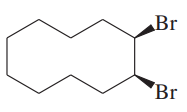
Show how you would make the following compounds from a suitable cyclic alkene.
(c) Chemical structure of a cyclic alkene with two bromine atoms attached, illustrating a halogenation reaction.

Verified step by step guidance
1
Identify the target compound: The given compound is a cyclic structure with two bromine atoms added to adjacent carbons in an anti configuration. This suggests the use of a halogenation reaction.
Choose a suitable cyclic alkene: The starting material should be a cyclic alkene with a double bond at the position where the bromine atoms will be added. For this compound, cyclooctene is a suitable choice.
Select the reagent: To add bromine atoms in an anti configuration, use molecular bromine (Br₂) in an inert solvent such as carbon tetrachloride (CCl₄). This reaction proceeds via a bromonium ion intermediate.
Describe the reaction mechanism: When Br₂ reacts with the cyclic alkene, the double bond attacks one bromine atom, forming a bromonium ion intermediate. The second bromine atom then attacks the more accessible carbon of the bromonium ion, leading to anti addition of bromine atoms.
Explain stereochemistry: The anti addition ensures that the bromine atoms are added to opposite faces of the ring, resulting in the observed stereochemistry of the product.

Verified video answer for a similar problem:

This video solution was recommended by our tutors as helpful for the problem above.
Video duration:
3m
Was this helpful?

Key Concepts

Here are the essential concepts you must grasp in order to answer the question correctly.

Cyclic Alkenes

Cyclic alkenes are hydrocarbons that contain a carbon ring with at least one carbon-carbon double bond. Their structure allows for unique reactivity patterns, particularly in addition reactions. Understanding the geometry and stability of these compounds is crucial for predicting the outcomes of reactions, such as halogenation.
Recommended video:
Guided course
06:23
Monosaccharides - Forming Cyclic Hemiacetals

Halogenation Reaction

Halogenation is a chemical reaction where halogens (like bromine) are added to a compound, typically across a double bond. In cyclic alkenes, this reaction can lead to the formation of vicinal dibromides, where two bromine atoms are added to adjacent carbon atoms. This process is important for synthesizing various organic compounds.
Recommended video:
Guided course
03:45
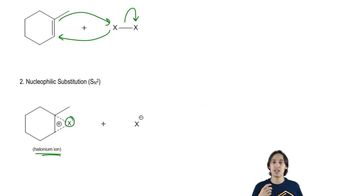
Halogenation Mechanism

Stereochemistry

Stereochemistry refers to the study of the spatial arrangement of atoms in molecules and how this affects their chemical behavior. In the context of halogenation of cyclic alkenes, understanding stereochemistry is essential for predicting the configuration of the resulting products, as the addition of bromine can lead to different stereoisomers depending on the reaction conditions.
Recommended video:
1:38
Polymer Stereochemistry Concept 1