
Ch.8 - Reactions of Alkenes
Wade - Organic Chemistry 9th Edition
Wade9th EditionOrganic ChemistryISBN: 9780135213728Not the one you use?Change textbook
Chapter 8, Problem 49f

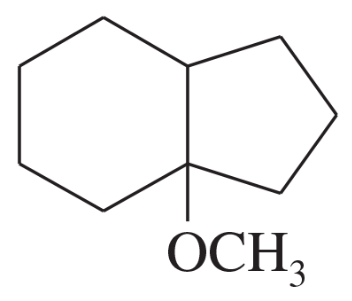
Show how you would make the following compounds from a suitable cyclic alkene.
(f)

Verified step by step guidance
1
Step 1: Identify the cyclic alkene that can serve as the starting material. In this case, a suitable starting material would be cyclohexene, as it provides the necessary cyclic structure for the final compound.
Step 2: Perform a ring expansion reaction to introduce the additional cyclopentane ring. This can be achieved using a carbene or other ring-expansion techniques, such as the Simmons-Smith reaction, to form the bicyclic structure.
Step 3: Introduce the methoxy group (-OCH3) at the desired position. This can be done through an electrophilic addition reaction using methanol (CH3OH) in the presence of an acid catalyst, such as H2SO4, to add the methoxy group to the double bond.
Step 4: Ensure regioselectivity and stereoselectivity during the addition of the methoxy group. The reaction conditions should favor the formation of the desired product with the correct orientation of the substituents.
Step 5: Purify the final product using techniques such as distillation or chromatography to isolate the desired compound and confirm its structure using spectroscopic methods like NMR or IR.

Verified video answer for a similar problem:

This video solution was recommended by our tutors as helpful for the problem above.
Video duration:
12m
Was this helpful?

Key Concepts

Here are the essential concepts you must grasp in order to answer the question correctly.

Cyclic Alkenes

Cyclic alkenes are hydrocarbons that contain a ring structure with at least one carbon-carbon double bond. They are important in organic synthesis as they can undergo various reactions, such as electrophilic addition and ring-opening reactions, to form more complex molecules. Understanding the reactivity of cyclic alkenes is crucial for designing synthetic pathways to target compounds.
Recommended video:
Guided course
06:23
Monosaccharides - Forming Cyclic Hemiacetals

Functional Groups

Functional groups are specific groups of atoms within molecules that are responsible for the characteristic chemical reactions of those molecules. In the context of the given compound, the methoxy group (–OCH3) is a functional group that can influence the reactivity and properties of the cyclic alkene. Recognizing and manipulating functional groups is essential for organic synthesis.
Recommended video:
Guided course
02:36
Identifying Functional Groups

Synthetic Pathways

Synthetic pathways refer to the series of chemical reactions that transform starting materials into desired products. In organic chemistry, understanding how to construct these pathways is vital for synthesizing complex molecules from simpler precursors. This involves knowledge of reaction mechanisms, stereochemistry, and the ability to predict the outcomes of reactions based on the starting materials used.
Recommended video:
2:13
Energy Production In Biochemical Pathways Concept 1