Ch. 7 - Structure and Synthesis of Alkenes; Elimination
Wade - Organic Chemistry 9th Edition
Wade9th EditionOrganic ChemistryISBN: 9780135213728Not the one you use?Change textbook
Chapter 7, Problem 58a

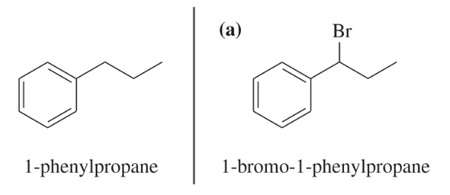
Show how you would convert (in one or two steps) 1-phenylpropane to the three products shown below. In each case, explain what unwanted reactions might produce undesirable impurities in the product.

Verified step by step guidance
1
Step 1: Analyze the target product, 1-bromo-1-phenylpropane, and identify the functional group transformation. The reaction involves the introduction of a bromine atom at the benzylic position (carbon adjacent to the benzene ring) of 1-phenylpropane.
Step 2: Select an appropriate reagent for bromination at the benzylic position. A common reagent for this transformation is bromine (Br₂) in the presence of light or a radical initiator such as N-bromosuccinimide (NBS). NBS is often preferred because it selectively brominates the benzylic position without affecting the aromatic ring.
Step 3: Write the reaction mechanism. The reaction proceeds via a radical mechanism: (a) Initiation: Light or heat generates bromine radicals from NBS. (b) Propagation: A benzylic hydrogen is abstracted by the bromine radical, forming a benzylic radical. (c) Termination: The benzylic radical reacts with bromine to form 1-bromo-1-phenylpropane.
Step 4: Consider potential side reactions. Unwanted reactions may include bromination of the aromatic ring or over-bromination at the benzylic position, leading to impurities. These can be minimized by controlling the reaction conditions, such as using a low concentration of bromine and avoiding excessive heat.
Step 5: Purify the product. After the reaction, the mixture may contain impurities. Techniques such as distillation or recrystallization can be used to isolate and purify 1-bromo-1-phenylpropane.

Verified video answer for a similar problem:

This video solution was recommended by our tutors as helpful for the problem above.
Video duration:
4m
Was this helpful?

Key Concepts

Here are the essential concepts you must grasp in order to answer the question correctly.

Electrophilic Substitution

Electrophilic substitution is a fundamental reaction in organic chemistry where an electrophile replaces a hydrogen atom in an aromatic compound. In the case of 1-phenylpropane, the aromatic ring can undergo electrophilic substitution to introduce a bromine atom, forming 1-bromo-1-phenylpropane. Understanding this mechanism is crucial for predicting the products of reactions involving aromatic compounds.
Recommended video:
Guided course
01:47
Nucleophiles and Electrophiles can react in Substitution Reactions.

Radical Halogenation

Radical halogenation is a reaction where alkanes react with halogens (like bromine) under heat or light to form alkyl halides. This process can lead to the formation of multiple products due to the possibility of multiple hydrogen atoms being replaced, which can result in unwanted side products. Recognizing the conditions that favor radical formation is essential for controlling the reaction outcome.
Recommended video:
Guided course
12:11
Radical Chain Reaction Mechanism.

Impurities and Side Reactions

In organic synthesis, side reactions can lead to impurities in the desired product. For example, in the bromination of 1-phenylpropane, competing reactions such as polysubstitution or rearrangement can occur, resulting in a mixture of products. Identifying potential side reactions helps in designing strategies to minimize impurities and improve the yield of the target compound.
Recommended video:
2:36
Side-Chain Reactions of Substituted Pyridines Concept 1
Related Practice
Textbook Question

Show how you would prepare cyclopentene from each compound.

c. cyclopentane (not by dehydrogenation)

2
views

Textbook Question

Show how you would convert (in one or two steps) 1-phenylpropane to the three products shown below. In each case, explain what unwanted reactions might produce undesirable impurities in the product.

6
views
Textbook Question

E1 eliminations of alkyl halides are rarely useful for synthetic purposes because they give mixtures of substitution and elimination products. Explain why the sulfuric acid-catalyzed dehydration of cyclohexanol gives a good yield of cyclohexene even though the reaction goes by an E1 mechanism. (Hint: What are the nucleophiles in the reaction mixture? What products are formed if these nucleophiles attack the carbocation? What further reactions can these substitution products undergo?)

3
views
Textbook Question

Show how you would convert (in one or two steps) 1-phenylpropane to the three products shown below. In each case, explain what unwanted reactions might produce undesirable impurities in the product.

1
views
Textbook Question

Show how you would prepare cyclopentene from each compound.

a. cyclopentanol

b. cyclopentyl bromide

1
views
Textbook Question

Using cyclohexane as your starting material, show how you would synthesize each of the following compounds. (Once you have shown how to synthesize a compound, you may use it as the starting material in any later parts of this problem.)

d. 3-bromocyclohex-1-ene

e. cyclohexa-1,3-diene

f. cyclohexanol

1
views