Ch. 7 - Structure and Synthesis of Alkenes; Elimination
Wade - Organic Chemistry 9th Edition
Wade9th EditionOrganic ChemistryISBN: 9780135213728Not the one you use?Change textbook
Chapter 7, Problem 59

E1 eliminations of alkyl halides are rarely useful for synthetic purposes because they give mixtures of substitution and elimination products. Explain why the sulfuric acid-catalyzed dehydration of cyclohexanol gives a good yield of cyclohexene even though the reaction goes by an E1 mechanism. (Hint: What are the nucleophiles in the reaction mixture? What products are formed if these nucleophiles attack the carbocation? What further reactions can these substitution products undergo?)

Verified step by step guidance
1
Step 1: Begin by understanding the E1 elimination mechanism. In an E1 reaction, the first step involves the formation of a carbocation intermediate after the leaving group departs. This intermediate is highly reactive and can undergo elimination or substitution reactions depending on the nucleophiles present in the reaction mixture.
Step 2: Analyze the reaction conditions. In the sulfuric acid-catalyzed dehydration of cyclohexanol, sulfuric acid acts as a proton donor, converting the hydroxyl group (-OH) of cyclohexanol into a better leaving group (water, H₂O). This facilitates the formation of the cyclohexyl carbocation.
Step 3: Identify the nucleophiles in the reaction mixture. In this case, the primary nucleophile is water (H₂O), which is abundant due to the dehydration process. Water can attack the carbocation to form substitution products, such as cyclohexanol, but this is reversible under acidic conditions.
Step 4: Consider the elimination pathway. The carbocation can lose a proton from a β-carbon, leading to the formation of cyclohexene via an E1 elimination. Cyclohexene is more stable under the reaction conditions because it is not prone to further reactions with water or sulfuric acid.
Step 5: Explain why substitution products are minimized. Any substitution products formed (e.g., cyclohexanol) can undergo further dehydration under the acidic conditions, regenerating the carbocation and favoring the formation of cyclohexene. This recycling process ensures a high yield of cyclohexene as the final product.

Verified video answer for a similar problem:

This video solution was recommended by our tutors as helpful for the problem above.
Video duration:
7m
Was this helpful?

Key Concepts

Here are the essential concepts you must grasp in order to answer the question correctly.

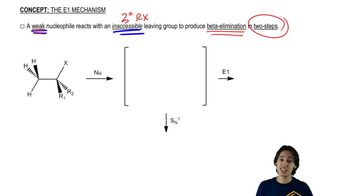
E1 Mechanism

The E1 mechanism is a two-step elimination process where the first step involves the formation of a carbocation intermediate after the leaving group departs. This is followed by the loss of a proton to form the alkene. Although E1 reactions can lead to both elimination and substitution products, the stability of the carbocation and the reaction conditions can favor the formation of alkenes, as seen in the dehydration of cyclohexanol.
Recommended video:
Guided course
08:09
Drawing the E1 Mechanism.

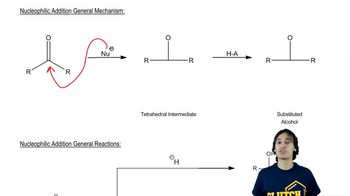
Nucleophiles in the Reaction Mixture

In the dehydration of cyclohexanol, the nucleophiles present in the reaction mixture include water and bisulfate ions from sulfuric acid. These nucleophiles can attack the carbocation formed during the E1 mechanism. The nature of these nucleophiles influences whether substitution or elimination products are formed, with water potentially leading to alcohols and bisulfate favoring elimination to form alkenes.
Recommended video:
Guided course
08:27
Nucleophilic Addition

Product Stability and Further Reactions

The stability of the products formed from the E1 mechanism plays a crucial role in determining the overall yield of cyclohexene. Substitution products, such as alcohols, can undergo further dehydration to form alkenes, thus enhancing the yield of cyclohexene. This ability of substitution products to participate in additional reactions helps to drive the equilibrium towards the desired alkene product.
Recommended video:
Guided course
03:43
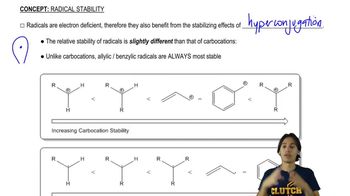
The radical stability trend.