
Ch. 7 - Structure and Synthesis of Alkenes; Elimination
Wade - Organic Chemistry 9th Edition
Wade9th EditionOrganic ChemistryISBN: 9780135213728Not the one you use?Change textbook
Chapter 7, Problem 11b

For each pair of compounds, predict the one with a higher boiling point. Which compounds have zero dipole moments?
b. cis- or trans-2,3-dichlorobut-2-ene

Verified step by step guidance
1
Identify the structural differences between cis- and trans-2,3-dichlorobut-2-ene. The cis isomer has both chlorine atoms on the same side of the double bond, while the trans isomer has them on opposite sides.
Consider the concept of molecular polarity. The cis isomer is polar because the dipoles from the chlorine atoms do not cancel out, resulting in a net dipole moment. The trans isomer is nonpolar because the dipoles cancel each other out, resulting in a zero dipole moment.
Recall that polar molecules generally have higher boiling points than nonpolar molecules due to stronger intermolecular forces (dipole-dipole interactions).
Predict that the cis-2,3-dichlorobut-2-ene will have a higher boiling point than the trans isomer due to its polarity and stronger intermolecular forces.
Conclude that the trans-2,3-dichlorobut-2-ene has a zero dipole moment, as the dipoles from the chlorine atoms cancel out in the trans configuration.

Verified video answer for a similar problem:

This video solution was recommended by our tutors as helpful for the problem above.
Video duration:
5m
Was this helpful?

Key Concepts

Here are the essential concepts you must grasp in order to answer the question correctly.

Boiling Point

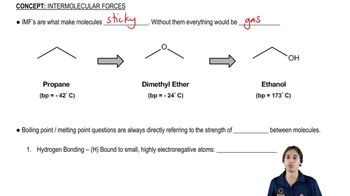
The boiling point of a compound is influenced by intermolecular forces such as hydrogen bonding, dipole-dipole interactions, and van der Waals forces. Stronger intermolecular forces result in higher boiling points. In the case of cis- and trans-2,3-dichlorobut-2-ene, the cis isomer typically has a higher boiling point due to stronger dipole-dipole interactions compared to the trans isomer.
Recommended video:
Guided course
03:08
How IMFs are related to melting and boiling points.

Dipole Moment

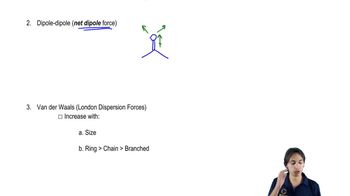
Dipole moment is a measure of the separation of positive and negative charges in a molecule. Molecules with symmetrical structures, like trans-2,3-dichlorobut-2-ene, often have zero dipole moments because the individual bond dipoles cancel each other out. In contrast, the cis isomer has a net dipole moment due to its asymmetrical structure.
Recommended video:
Guided course
01:46
How dipole-dipole forces work.

Cis-Trans Isomerism

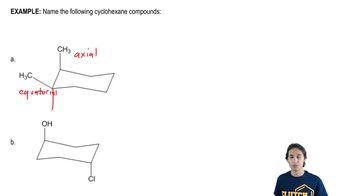
Cis-trans isomerism, a type of stereoisomerism, occurs due to the restricted rotation around double bonds. Cis isomers have substituents on the same side, leading to polar molecules, while trans isomers have substituents on opposite sides, often resulting in nonpolar molecules. This affects properties like boiling point and dipole moment, as seen in 2,3-dichlorobut-2-ene.
Recommended video:
Guided course
00:44
Is the following cyclohexane cis or trans?
Related Practice
Textbook Question

Using Table 7-2 as a guide, predict which member of each pair is more stable, as well as by about how many kJ/mol or kcal/mol.

a. cis,cis-hexa-2,4-diene or trans,trans-hexa-2,4-diene

b. 2-methylbut-1-ene or 3-methylbut-1-ene

c. 2-methylbut-1-ene or 2-methylbut-2-ene

d. cis-4-methylpent-2-ene or 2-methylpent-2-ene

3
views
Textbook Question

For each pair of compounds, predict the one with a higher boiling point. Which compounds have zero dipole moments?

c. cyclohexene or 1,2-dichlorocyclohexene

2
views
Textbook Question

Draw the six stereoisomers of octa-2,4,6-triene. Explain why there are only six stereoisomers, rather than the eight we might expect for a compound with three stereogenic double bonds.

1
views
Textbook Question

Teflon-coated frying pans routinely endure temperatures that would cause polyethylene or polypropylene to oxidize and decompose. Decomposition of polyethylene is initiated by free-radical abstraction of a hydrogen atom by O2. Bond-dissociation energies of C—H bonds are about 400 kJ/mol, and C—F bonds are about 460 kJ/mol. The BDE of the H—OO bond is about 192 kJ/mol, and the F—OO bond is about 63 kJ/mol. Show why Teflon (Figure 7-5) is much more resistant to oxidation than polyethylene is.

3
views
Textbook Question

For each pair of compounds, predict the one with a higher boiling point. Which compounds have zero dipole moments?

a. cis-1,2-dichloroethene or cis-1,2-dibromoethene

3
views
Textbook Question

Use the data in Table 7-2 to predict the energy difference between 2,3-dimethylbut-1-ene and 2,3-dimethylbut-2-ene. Which of these double-bond isomers is more stable?

1
views