Ch. 7 - Structure and Synthesis of Alkenes; Elimination
Wade - Organic Chemistry 9th Edition
Wade9th EditionOrganic ChemistryISBN: 9780135213728Not the one you use?Change textbook
Chapter 7, Problem 9b

Draw the six stereoisomers of octa-2,4,6-triene. Explain why there are only six stereoisomers, rather than the eight we might expect for a compound with three stereogenic double bonds.

Verified step by step guidance
1
Step 1: Understand the structure of octa-2,4,6-triene. It is a linear hydrocarbon with three conjugated double bonds located at positions 2, 4, and 6. Each double bond can exhibit cis (Z) or trans (E) stereochemistry, which contributes to the stereoisomer count.
Step 2: Recall that for a molecule with three stereogenic double bonds, we might initially expect 2^3 = 8 stereoisomers (since each double bond can independently be cis or trans). However, conjugation and molecular symmetry reduce the number of stereoisomers.
Step 3: Consider the conjugation of the double bonds. The π-electron system in conjugated double bonds imposes restrictions on the spatial arrangement of the molecule, limiting the possible combinations of cis and trans configurations.
Step 4: Analyze the symmetry of the molecule. Octa-2,4,6-triene has a symmetrical structure, which means some stereoisomers are identical due to reflection symmetry. This further reduces the number of unique stereoisomers.
Step 5: Draw the six stereoisomers systematically. Assign cis (Z) or trans (E) configurations to each double bond while ensuring that you account for conjugation and symmetry. Label each stereoisomer clearly and verify that no duplicates are included in your set of six.

Verified video answer for a similar problem:

This video solution was recommended by our tutors as helpful for the problem above.
Video duration:
4m
Was this helpful?

Key Concepts

Here are the essential concepts you must grasp in order to answer the question correctly.

Stereoisomerism

Stereoisomerism refers to the phenomenon where compounds have the same molecular formula and connectivity of atoms but differ in the spatial arrangement of their atoms. In the case of octa-2,4,6-triene, the presence of double bonds introduces geometric isomerism, leading to different configurations (cis/trans) around each double bond. Understanding stereoisomerism is crucial for determining the number of unique isomers a compound can have.
Recommended video:
Guided course
01:58
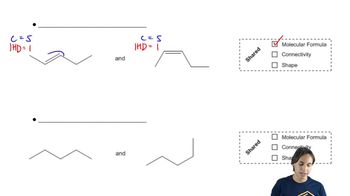
Determining when molecules are stereoisomers.

Stereogenic Centers

Stereogenic centers are atoms in a molecule that can lead to stereoisomerism when they are bonded to different substituents. In octa-2,4,6-triene, the double bonds can act as stereogenic centers, but not all double bonds contribute to the total count of stereoisomers due to symmetry and the presence of equivalent configurations. Recognizing which parts of a molecule are stereogenic is essential for calculating the total number of stereoisomers.
Recommended video:
Guided course
02:38
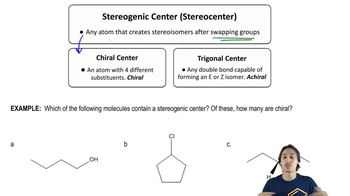
The difference between chiral and trigonal centers.

Symmetry and Equivalent Configurations

Symmetry in a molecule can reduce the number of unique stereoisomers by creating equivalent configurations that do not result in distinct isomers. In octa-2,4,6-triene, the arrangement of double bonds and their substituents leads to certain configurations being indistinguishable from one another. This concept explains why, despite having three stereogenic double bonds, only six unique stereoisomers exist instead of the expected eight.
Recommended video:
Guided course
02:14
The Electron Configuration