
Ch.5 - Stereochemistry
Wade - Organic Chemistry 9th Edition
Wade9th EditionOrganic ChemistryISBN: 9780135213728Not the one you use?Change textbook
Chapter 5, Problem 21c,d

Which of the following compounds are chiral? Draw each compound in its most symmetric conformation, star (*) any asymmetric carbon atoms, and draw any mirror planes. Label any meso compounds. You may use Fischer projections if you prefer.
(c) (2R,3S)-2-bromo-3-chlorobutane
(d) (2R,3S)-2,3-dibromobutane

Verified step by step guidance
1
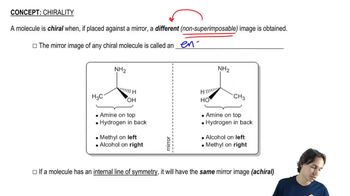
Step 1: Begin by understanding the concept of chirality. A molecule is chiral if it is non-superimposable on its mirror image. This typically requires the presence of at least one asymmetric carbon atom (a carbon bonded to four different groups). Meso compounds, on the other hand, are achiral despite having asymmetric carbons due to an internal plane of symmetry.
Step 2: For compound (2R,3S)-2-bromo-3-chlorobutane, draw the structure in its most symmetric conformation. Assign the R and S configurations to the stereocenters using the Cahn-Ingold-Prelog priority rules. Identify any asymmetric carbon atoms (star (*) them) and check for the presence of a mirror plane.
Step 3: For compound (2R,3S)-2,3-dibromobutane, draw the structure in its most symmetric conformation. Assign the R and S configurations to the stereocenters using the Cahn-Ingold-Prelog priority rules. Identify any asymmetric carbon atoms (star (*) them) and check for the presence of a mirror plane.
Step 4: Determine whether each compound is chiral or achiral. If a compound has an internal plane of symmetry, it is achiral and may be classified as a meso compound. Label any meso compounds accordingly.
Step 5: Use Fischer projections if preferred to simplify the visualization of symmetry and stereochemistry. Ensure that the stereochemical configurations (R/S) are correctly represented in the Fischer projection and confirm the presence or absence of chirality or meso characteristics.

Verified video answer for a similar problem:

This video solution was recommended by our tutors as helpful for the problem above.
Video duration:
14m
Was this helpful?

Key Concepts

Here are the essential concepts you must grasp in order to answer the question correctly.

Chirality

Chirality refers to the geometric property of a molecule that makes it non-superimposable on its mirror image. A chiral molecule typically has at least one asymmetric carbon atom, which is a carbon atom bonded to four different substituents. This property is crucial in organic chemistry as chiral compounds can exhibit different biological activities and properties.
Recommended video:
Guided course
05:10
What is chirality?

Asymmetric Carbon Atom

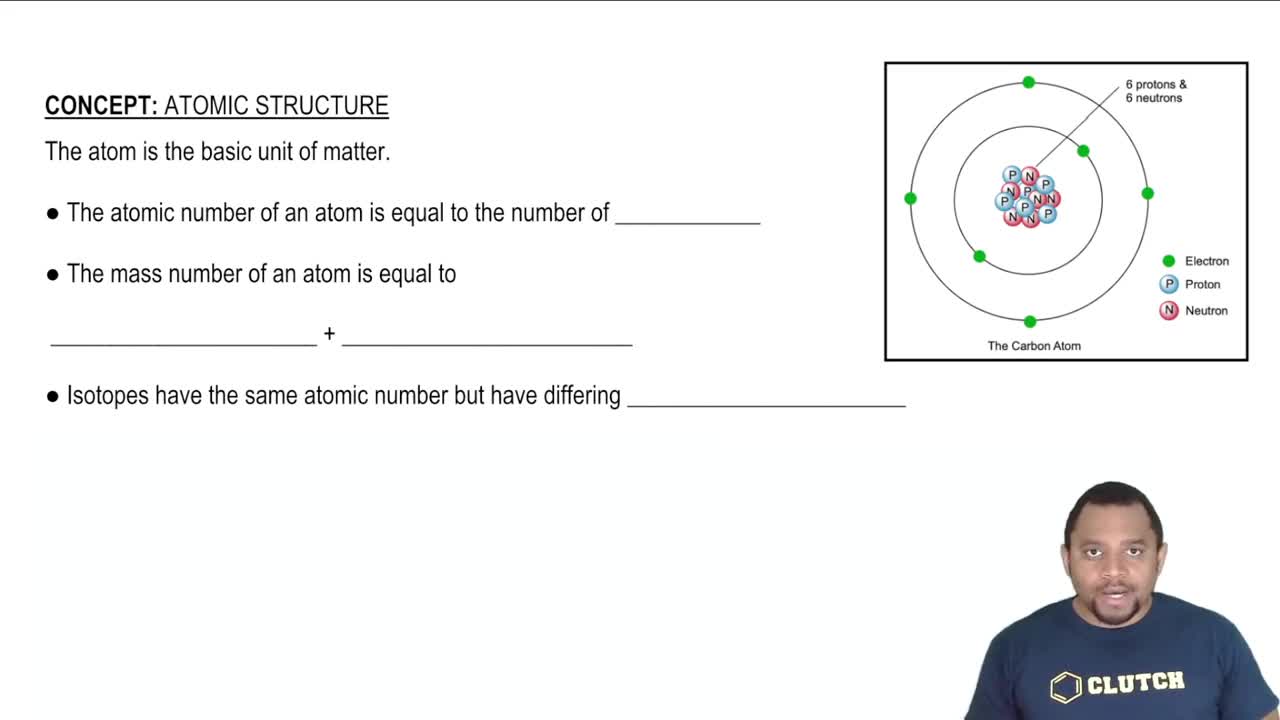
An asymmetric carbon atom, also known as a chiral center, is a carbon atom that is attached to four different groups or atoms. The presence of such a carbon in a molecule is what gives rise to chirality. Identifying these centers is essential for determining whether a compound is chiral or achiral, as well as for understanding the stereochemistry of the compound.
Recommended video:
Guided course
01:44
The difference between atomic numbers and atomic mass.

Meso Compounds

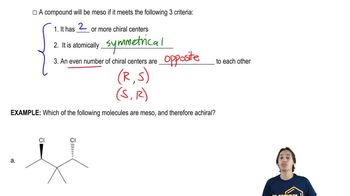
Meso compounds are a specific type of achiral compound that contains multiple chiral centers but also has an internal plane of symmetry. This symmetry allows the molecule to be superimposed on its mirror image, despite having chiral centers. Recognizing meso compounds is important in stereochemistry, as they can often be mistaken for chiral compounds due to their chiral centers.
Recommended video:
Guided course
04:10
The 3 rules of meso compounds.