
Ch.5 - Stereochemistry
Wade - Organic Chemistry 9th Edition
Wade9th EditionOrganic ChemistryISBN: 9780135213728Not the one you use?Change textbook
Chapter 5, Problem 20h

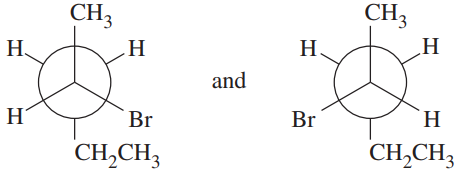
For each pair, give the relationship between the two compounds. Making models will be helpful.
(h) Two molecular structures showing isomers with different arrangements of atoms and bonds, labeled with chemical groups.

Verified step by step guidance
1
Step 1: Analyze the structures of the two compounds provided in the image. Both compounds are drawn as Newman projections, which represent the spatial arrangement of substituents around a single bond.
Step 2: Identify the substituents attached to the front and back carbons in each Newman projection. For both compounds, the front carbon has substituents CH₃, H, and Br, while the back carbon has substituents CH₂CH₃, H, and H.
Step 3: Compare the spatial arrangement of substituents in the two Newman projections. In the first compound, the CH₃ group on the front carbon is staggered relative to the CH₂CH₃ group on the back carbon, while in the second compound, the CH₃ group is staggered relative to a hydrogen atom on the back carbon.
Step 4: Determine the relationship between the two compounds based on their spatial arrangement. Since the substituents are staggered differently, the compounds are conformational isomers (specifically, different staggered conformations of the same molecule).
Step 5: Conclude that the relationship between the two compounds is that they are conformational isomers, which differ in the rotation around the single bond connecting the front and back carbons.

Verified video answer for a similar problem:

This video solution was recommended by our tutors as helpful for the problem above.
Video duration:
3m
Was this helpful?

Key Concepts

Here are the essential concepts you must grasp in order to answer the question correctly.

Isomerism

Isomerism refers to the phenomenon where two or more compounds have the same molecular formula but different structural arrangements of atoms. This can lead to variations in physical and chemical properties. In organic chemistry, isomers can be classified into structural isomers, which differ in the connectivity of atoms, and stereoisomers, which differ in the spatial arrangement of atoms.
Recommended video:
Guided course
06:47
Monosaccharides - D and L Isomerism

Cyclic Compounds

Cyclic compounds are organic molecules that contain a ring structure formed by the bonding of carbon atoms. These compounds can be saturated (with single bonds) or unsaturated (with double or triple bonds). The ring structure can significantly influence the chemical reactivity and stability of the compound, as well as its physical properties.
Recommended video:
Guided course
01:40
Defining meso compounds.

Substituents

Substituents are atoms or groups of atoms that replace hydrogen atoms in a hydrocarbon chain or ring. They can affect the reactivity, polarity, and overall properties of the compound. In the context of the provided image, the presence of bromine (Br) and alkyl groups (like CH3 and CH2CH3) as substituents leads to different isomeric forms, impacting the compound's behavior in chemical reactions.
Recommended video:
Guided course
01:47
Nucleophiles and Electrophiles can react in Substitution Reactions.