Ch.4 - The Study of Chemical Reactions
Wade - Organic Chemistry 9th Edition
Wade9th EditionOrganic ChemistryISBN: 9780135213728Not the one you use?Change textbook
Chapter 4, Problem 3a

Each of the following proposed mechanisms for the free-radical chlorination of methane is wrong. Explain how the experimental evidence disproves each mechanism.
a.

Verified step by step guidance
1
The first step is to analyze the proposed mechanism. The mechanism suggests that chlorine gas (Cl₂) absorbs light energy (hv) to form an 'activated' form of Cl₂, denoted as Cl₂*. This activated Cl₂* is then proposed to react directly with methane (CH₄) to produce HCl and CH₃Cl in a single step.
Next, consider the experimental evidence for free-radical chlorination. Experimental studies show that the reaction proceeds through a chain mechanism involving free radicals, not through a single-step reaction as proposed here. The chain mechanism includes initiation, propagation, and termination steps, which are absent in this proposed mechanism.
In the initiation step of the actual mechanism, light energy (hv) breaks the Cl-Cl bond in Cl₂ to form two chlorine radicals (Cl•). This is supported by experimental evidence showing the presence of free radicals during the reaction. The proposed mechanism does not account for this radical formation.
In the propagation steps of the actual mechanism, a chlorine radical (Cl•) reacts with methane (CH₄) to form HCl and a methyl radical (CH₃•). The methyl radical then reacts with another Cl₂ molecule to form CH₃Cl and regenerate a chlorine radical. These steps explain the chain reaction observed experimentally, which the proposed mechanism fails to address.
Finally, the proposed mechanism does not explain the observed reaction kinetics. Experimental evidence shows that the reaction rate depends on the concentration of Cl• radicals, which are not generated in the proposed mechanism. This discrepancy further disproves the validity of the proposed mechanism.

Verified video answer for a similar problem:

This video solution was recommended by our tutors as helpful for the problem above.
Video duration:
6m
Was this helpful?

Key Concepts

Here are the essential concepts you must grasp in order to answer the question correctly.

Free Radical Mechanism

The free radical mechanism involves the formation of reactive species called free radicals, which are atoms or molecules with unpaired electrons. In the context of chlorination, the process typically includes initiation, propagation, and termination steps. Understanding this mechanism is crucial for analyzing how chlorination occurs and why certain proposed mechanisms may not align with experimental observations.
Recommended video:
Guided course
03:28
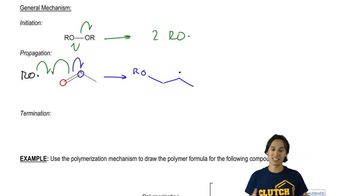
The mechanism of Radical Polymerization.

Chlorination of Methane

Chlorination of methane is a reaction where chlorine (Cl2) reacts with methane (CH4) to produce chloromethane (CH3Cl) and hydrochloric acid (HCl). This reaction is significant in organic chemistry as it illustrates the principles of radical substitution. Experimental evidence, such as the products formed and their ratios, can provide insights into the validity of proposed mechanisms for this reaction.
Recommended video:
Guided course
00:48
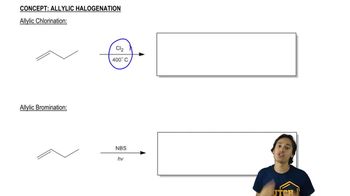
The products of Allylic Chlorination.

Experimental Evidence

Experimental evidence refers to data and observations obtained through scientific experiments that can support or refute a hypothesis or proposed mechanism. In the case of chlorination, evidence such as product distribution, reaction rates, and the presence of intermediates can help determine whether a proposed mechanism accurately describes the reaction. Discrepancies between expected and observed results can lead to the rejection of certain mechanisms.
Recommended video:
Guided course
04:09
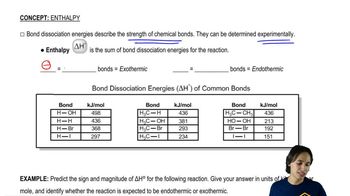
How to calculate enthalpy using bond dissociation energies.