Ch.4 - The Study of Chemical Reactions
Wade - Organic Chemistry 9th Edition
Wade9th EditionOrganic ChemistryISBN: 9780135213728Not the one you use?Change textbook
Chapter 4, Problem 2c

How could an industrial plant control the proportions of methane and chlorine to favor production of CCl4? To favor production of CH3Cl?

Verified step by step guidance
1
Understand the reaction: Methane (CH₄) reacts with chlorine (Cl₂) in a free radical substitution reaction to produce chlorinated methane derivatives such as CH₃Cl, CH₂Cl₂, CHCl₃, and CCl₄. The proportions of methane and chlorine influence which product is favored.
To favor production of CCl₄: Increase the proportion of chlorine relative to methane. Excess chlorine ensures that all hydrogen atoms in methane are replaced by chlorine atoms, leading to the formation of CCl₄. This is because the reaction proceeds through successive substitutions, and an abundance of chlorine drives the reaction toward complete substitution.
To favor production of CH₃Cl: Use a higher proportion of methane relative to chlorine. Excess methane limits the availability of chlorine for further substitution, favoring the formation of the monosubstituted product CH₃Cl. This approach minimizes the chances of further substitution reactions.
Control reaction conditions: Adjust temperature and light intensity to optimize the reaction. Free radical substitution reactions are initiated by UV light or heat, which generates chlorine radicals. Controlling these factors can help regulate the rate of substitution and the extent of the reaction.
Monitor and separate products: Use techniques such as distillation or gas chromatography to separate and analyze the products formed. This ensures that the desired product (CCl₄ or CH₃Cl) is obtained in higher yield and purity.

Verified video answer for a similar problem:

This video solution was recommended by our tutors as helpful for the problem above.
Video duration:
4m
Was this helpful?

Key Concepts

Here are the essential concepts you must grasp in order to answer the question correctly.

Reaction Equilibrium

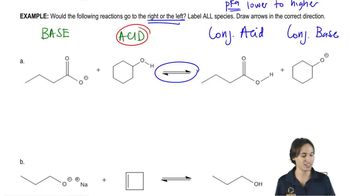
In chemical reactions, equilibrium refers to the state where the rates of the forward and reverse reactions are equal, resulting in constant concentrations of reactants and products. Understanding Le Chatelier's principle is crucial, as it states that if a system at equilibrium is disturbed, it will shift in a direction that counteracts the disturbance. This principle can be applied to control the proportions of reactants like methane and chlorine to favor the production of desired products such as CCl4 or CH3Cl.
Recommended video:
Guided course
04:00
Determining Acid/Base Equilibrium

Stoichiometry

Stoichiometry involves the calculation of reactants and products in chemical reactions based on balanced chemical equations. It is essential for determining the exact proportions of methane and chlorine needed to produce specific amounts of CCl4 or CH3Cl. By understanding the stoichiometric ratios, industrial plants can optimize their reactant inputs to achieve desired product yields efficiently.
Recommended video:
Guided course
02:08
Organic molecules in your everyday life.

Catalysis

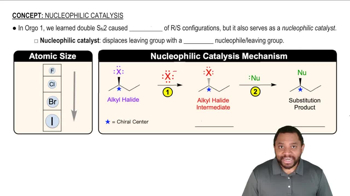
Catalysis is the process of increasing the rate of a chemical reaction by adding a substance known as a catalyst, which is not consumed in the reaction. In industrial settings, catalysts can be used to favor the formation of specific products, such as CCl4 or CH3Cl, by lowering the activation energy required for the reaction. This can help control the reaction conditions and improve the efficiency of the production process.
Recommended video:
2:31
Nucleophilic Catalysis Concept 1