Ch.3 - Structure and Stereochemistry of Alkanes
Wade - Organic Chemistry 9th Edition
Wade9th EditionOrganic ChemistryISBN: 9780135213728Not the one you use?Change textbook
Chapter 3, Problem 3

The heat of combustion of cis-1,2-dimethylcyclopropane is larger than that of the trans isomer. Which isomer is more stable? Use drawings to explain this difference in stability

Verified step by step guidance
1
Identify the structural differences between cis-1,2-dimethylcyclopropane and trans-1,2-dimethylcyclopropane. The cis isomer has both methyl groups on the same side of the cyclopropane ring, while the trans isomer has them on opposite sides.
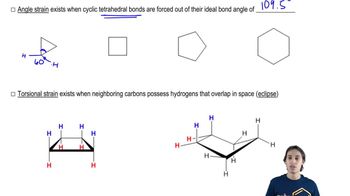
Consider the concept of ring strain in cyclopropane. Cyclopropane rings are inherently strained due to their small size and the angle strain from the 60° bond angles, which are much smaller than the ideal tetrahedral angle of 109.5°.
Analyze how the positioning of the methyl groups affects the overall strain. In the cis isomer, the proximity of the methyl groups can lead to increased steric hindrance and torsional strain, as they are on the same side of the ring.
Compare the steric interactions in the trans isomer. The trans configuration allows the methyl groups to be on opposite sides, reducing steric hindrance and torsional strain compared to the cis isomer.
Conclude that the trans isomer is more stable due to lower steric hindrance and torsional strain, which is reflected in its lower heat of combustion compared to the cis isomer.

Verified video answer for a similar problem:

This video solution was recommended by our tutors as helpful for the problem above.
Video duration:
3m
Was this helpful?

Key Concepts

Here are the essential concepts you must grasp in order to answer the question correctly.

Cis-Trans Isomerism

Cis-trans isomerism refers to the different spatial arrangements of atoms in a molecule that can occur due to restricted rotation around a double bond or a ring structure. In the case of cyclopropane derivatives, the 'cis' isomer has substituents on the same side of the ring, while the 'trans' isomer has them on opposite sides. This spatial arrangement affects steric interactions and overall stability.
Recommended video:
Guided course
00:44
Is the following cyclohexane cis or trans?

Heat of Combustion

The heat of combustion is the amount of energy released when a substance is completely burned in oxygen. It serves as an indicator of the stability of a compound; a higher heat of combustion typically suggests that the compound is less stable, as it releases more energy upon combustion. Thus, comparing the heats of combustion of isomers can provide insights into their relative stabilities.
Recommended video:
Guided course
02:55
Heat of Combustion

Stability and Strain in Cyclopropanes

Cyclopropanes are known for their ring strain due to the 60-degree bond angles that deviate significantly from the ideal tetrahedral angle of 109.5 degrees. This strain can be influenced by the arrangement of substituents in cis and trans isomers. The trans isomer generally experiences less steric hindrance and strain, making it more stable than the cis isomer, which has increased steric interactions between substituents.
Recommended video:
Guided course
02:46
What is angle strain?