Ch.3 - Structure and Stereochemistry of Alkanes
Wade - Organic Chemistry 9th Edition
Wade9th EditionOrganic ChemistryISBN: 9780135213728Not the one you use?Change textbook
Chapter 3, Problem 3

The following names are all incorrect or incomplete, but they represent real structures. Draw each structure and name it correctly.a. 2-ethylpentaneb. 3-isopropylhexane

Verified step by step guidance
1
Identify the parent chain in each name. For '2-ethylpentane', the parent chain is 'pentane', which means a 5-carbon chain. For '3-isopropylhexane', the parent chain is 'hexane', which means a 6-carbon chain.
For '2-ethylpentane', place the ethyl group on the second carbon of the pentane chain. However, check if this structure can be simplified to a more standard IUPAC name.
For '3-isopropylhexane', place the isopropyl group on the third carbon of the hexane chain. Again, verify if this structure can be simplified to a more standard IUPAC name.
Draw the structures based on the placement of substituents and ensure that the longest carbon chain is identified correctly in each case.
Rename the structures using IUPAC nomenclature rules, ensuring that the substituents are correctly numbered and the name reflects the longest carbon chain.

Verified video answer for a similar problem:

This video solution was recommended by our tutors as helpful for the problem above.
Video duration:
3m
Was this helpful?

Key Concepts

Here are the essential concepts you must grasp in order to answer the question correctly.

IUPAC Nomenclature

IUPAC nomenclature is a systematic method for naming organic chemical compounds. It provides rules for identifying the longest carbon chain, substituents, and their positions, ensuring that each compound has a unique and descriptive name. Understanding these rules is essential for correctly interpreting and constructing names like '2-ethylpentane' and '3-isopropylhexane'.
Recommended video:
Guided course
03:43
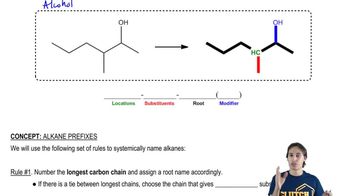
The different parts of an IUPAC name

Structural Representation

Structural representation involves depicting the arrangement of atoms within a molecule, which can be illustrated through various formats such as Lewis structures, condensed formulas, or skeletal structures. Accurately drawing these structures is crucial for visualizing the compound's geometry and understanding its chemical properties, especially when correcting incomplete names.
Recommended video:
Guided course
05:09
Representations of L-Configuration

Substituent Identification

Substituent identification refers to recognizing and naming the branches or functional groups attached to the main carbon chain in an organic molecule. In the examples given, understanding how to identify and correctly position substituents like 'ethyl' and 'isopropyl' is vital for accurately naming the compounds and ensuring that the structures reflect their correct nomenclature.
Recommended video:
Guided course
01:47
Nucleophiles and Electrophiles can react in Substitution Reactions.