Ch.3 - Structure and Stereochemistry of Alkanes
Wade - Organic Chemistry 9th Edition
Wade9th EditionOrganic ChemistryISBN: 9780135213728Not the one you use?Change textbook
Chapter 3, Problem 25a

Draw the most stable conformation of
a. ethylcyclohexane.

Verified step by step guidance
1
Start by understanding the structure of cyclohexane. Cyclohexane is a six-membered ring that can adopt different conformations, with the chair conformation being the most stable due to minimized steric strain and torsional strain.
Identify the substituent group in ethylcyclohexane, which is the ethyl group (C₂H₅). This group will be attached to one of the carbon atoms in the cyclohexane ring.
Consider the chair conformation of cyclohexane. In this conformation, each carbon atom has two positions for substituents: axial (pointing up or down, perpendicular to the ring) and equatorial (pointing outwards, parallel to the ring).
Place the ethyl group in the equatorial position on the cyclohexane ring. This position is preferred for larger groups like ethyl because it minimizes steric hindrance and is more stable than the axial position.
Draw the complete structure of ethylcyclohexane in the chair conformation with the ethyl group in the equatorial position. Ensure that the hydrogen atoms are appropriately placed in axial and equatorial positions to complete the conformation.

Verified video answer for a similar problem:

This video solution was recommended by our tutors as helpful for the problem above.
Video duration:
3m
Was this helpful?

Key Concepts

Here are the essential concepts you must grasp in order to answer the question correctly.

Cyclohexane Conformations

Cyclohexane can adopt several conformations, with the chair conformation being the most stable due to minimized steric strain and torsional strain. In the chair form, carbon atoms are staggered, reducing repulsion between hydrogen atoms. Understanding these conformations is crucial for predicting the stability of substituted cyclohexanes.
Recommended video:
Guided course
03:29
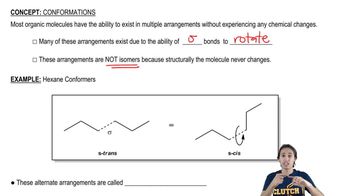
Understanding what a conformer is.

Axial and Equatorial Positions

In the chair conformation of cyclohexane, substituents can occupy axial or equatorial positions. Axial positions are perpendicular to the ring plane, while equatorial positions are parallel. Substituents prefer equatorial positions to minimize steric hindrance, which is key to determining the most stable conformation of substituted cyclohexanes like ethylcyclohexane.
Recommended video:
Guided course
04:02
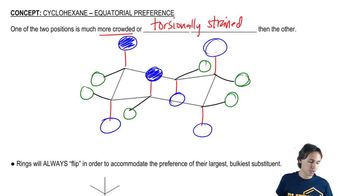
Equatorial Preference

Steric Hindrance

Steric hindrance occurs when atoms or groups are too close, causing repulsion and destabilizing the molecule. In cyclohexane derivatives, larger groups in axial positions experience more steric hindrance due to 1,3-diaxial interactions. Placing bulky groups like ethyl in equatorial positions reduces steric strain, leading to a more stable conformation.
Recommended video:
Guided course
02:53
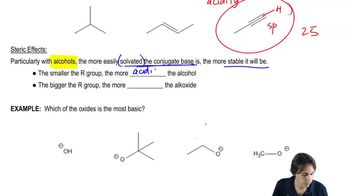
Understanding steric effects.