
Textbook Question
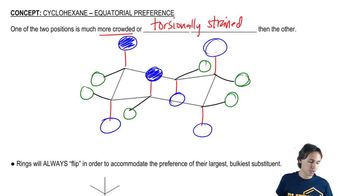
Draw 1,2,3,4,5,6-hexamethylcyclohexane with all the methyl groups
a. in axial positions.
4
views

 Verified step by step guidance
 03:29
03:29
 04:02
04:02 2:02
2:02Draw 1,2,3,4,5,6-hexamethylcyclohexane with all the methyl groups
a. in axial positions.
Draw the most stable conformation of
a. ethylcyclohexane.
Table 3-6 shows that the axial–equatorial energy difference for methyl, ethyl, and isopropyl groups increases gradually: 7.6, 7.9, and 8.8 kJ/mol (1.8, 1.9, and 2.1 kcal/mol). The tert-butyl group jumps to an energy difference of 23 kJ/mol (5.4 kcal/mol), over twice the value for the isopropyl group. Draw pictures of the axial conformations of isopropylcyclohexane and tert-butylcyclohexane, and explain why the tert-butyl substituent experiences such a large increase in axial energy over the isopropyl group.
trans-1,2-Dimethylcyclobutane is more stable than cis-1,2-dimethylcyclobutane, but cis-1,3-dimethylcyclobutane is more stable than trans-1,3-dimethylcyclobutane. Use drawings to explain these observations.
Draw a Newman projection, similar to Figure 3-25 down the C1—C6 bond in the equatorial conformation of methylcyclohexane. Show that the equatorial methyl group is also anti to C5. (Using your models will help.)
<IMAGE>
The cyclohexane chair shown in Figure 3-22 has the headrest to the right and the footrest to the left. Draw a cyclohexane chair with its axial and equatorial bonds, showing the headrest to the left and the footrest to the right.