Ch. 22 - Condensations and Alpha Substitutions of Carbonyl Compounds
Wade - Organic Chemistry 9th Edition
Wade9th EditionOrganic ChemistryISBN: 9780135213728Not the one you use?Change textbook
Chapter 22, Problem 37

Propose a mechanism for the self-condensation of methyl 3-phenylpropionate promoted by sodium methoxide.

Verified step by step guidance
1
Identify the reaction type: The self-condensation of methyl 3-phenylpropionate is a Claisen condensation, which involves the reaction of two ester molecules in the presence of a strong base to form a β-keto ester.
Step 1: Deprotonation of the α-hydrogen. Sodium methoxide (a strong base) abstracts the acidic α-hydrogen from one molecule of methyl 3-phenylpropionate, forming a resonance-stabilized enolate ion. Represent the enolate ion as: CH2(C6H5)COOCH3 → CH(C6H5)=C-OCH3.
Step 2: Nucleophilic attack by the enolate. The enolate ion acts as a nucleophile and attacks the carbonyl carbon of a second molecule of methyl 3-phenylpropionate. This forms a tetrahedral intermediate. Represent the intermediate as: CH(C6H5)=C-OCH3 + CH2(C6H5)COOCH3 → [tetrahedral intermediate].
Step 3: Elimination of methoxide ion. The tetrahedral intermediate collapses, expelling a methoxide ion (CH3O-) and forming the β-keto ester product. Represent the product as: CH(C6H5)COCH(C6H5)COOCH3.
Step 4: Regeneration of the base. The expelled methoxide ion can deprotonate another molecule of methyl 3-phenylpropionate, continuing the catalytic cycle. This ensures that sodium methoxide is regenerated and can promote further reactions.

Verified video answer for a similar problem:

This video solution was recommended by our tutors as helpful for the problem above.
Was this helpful?

Key Concepts

Here are the essential concepts you must grasp in order to answer the question correctly.

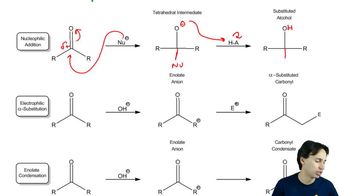
Self-Condensation

Self-condensation is a reaction where a molecule reacts with itself to form a larger compound. In the case of methyl 3-phenylpropionate, this process involves the formation of a new carbon-carbon bond between two identical molecules, leading to the creation of a dimer or oligomer. Understanding this concept is crucial for predicting the products and mechanisms involved in the reaction.
Recommended video:
Guided course
05:53
Condensation Reactions

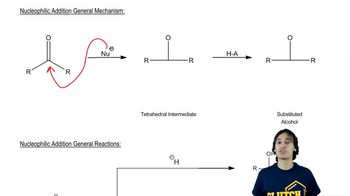
Nucleophilic Attack

Nucleophilic attack is a fundamental reaction mechanism in organic chemistry where a nucleophile, which is an electron-rich species, attacks an electrophile, an electron-deficient species. In this scenario, sodium methoxide acts as a nucleophile, attacking the carbonyl carbon of methyl 3-phenylpropionate, facilitating the formation of a new bond. This step is essential for understanding how the self-condensation occurs.
Recommended video:
Guided course
08:27
Nucleophilic Addition

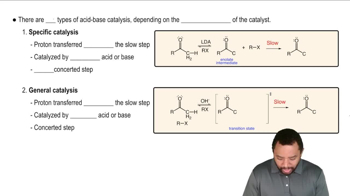
Base Catalysis

Base catalysis refers to the acceleration of a chemical reaction by a base, which can deprotonate acidic protons and generate nucleophiles. In this reaction, sodium methoxide not only serves as a nucleophile but also acts as a base, enhancing the reactivity of the carbonyl compound. Recognizing the role of base catalysis is vital for comprehending the overall mechanism of the self-condensation process.
Recommended video:
2:50
Acid-Base Catalysis Concept 3