Ch. 22 - Condensations and Alpha Substitutions of Carbonyl Compounds
Wade - Organic Chemistry 9th Edition
Wade9th EditionOrganic ChemistryISBN: 9780135213728Not the one you use?Change textbook
Chapter 22, Problem 36a,b

Predict the products of self-condensation of the following esters.
(a) methyl propanoate + NaOCH3
(b) ethyl phenylacetate + NaOCH2CH3

Verified step by step guidance
1
Step 1: Recognize that the reaction involves the Claisen condensation, a reaction where esters undergo self-condensation in the presence of a strong base to form β-keto esters. The base used must match the alkoxide group of the ester to avoid transesterification.
Step 2: For part (a), methyl propanoate reacts with sodium methoxide (NaOCH3). Deprotonation of the α-hydrogen (hydrogen on the carbon adjacent to the carbonyl group) by the base generates an enolate ion. Write the enolate ion structure for methyl propanoate.
Step 3: The enolate ion then acts as a nucleophile and attacks the carbonyl carbon of another molecule of methyl propanoate. This forms a tetrahedral intermediate. Write the structure of the tetrahedral intermediate.
Step 4: The tetrahedral intermediate collapses, expelling a methoxide ion (CH3O⁻) as the leaving group. This results in the formation of a β-keto ester. Write the structure of the β-keto ester product for part (a).
Step 5: For part (b), ethyl phenylacetate reacts with sodium ethoxide (NaOCH2CH3). Follow the same steps as in part (a): deprotonation of the α-hydrogen to form the enolate ion, nucleophilic attack on another molecule of ethyl phenylacetate, formation of the tetrahedral intermediate, and expulsion of the ethoxide ion to yield the β-keto ester product. Write the structure of the β-keto ester product for part (b).

Verified video answer for a similar problem:

This video solution was recommended by our tutors as helpful for the problem above.
Video duration:
5m
Was this helpful?

Key Concepts

Here are the essential concepts you must grasp in order to answer the question correctly.

Self-Condensation of Esters

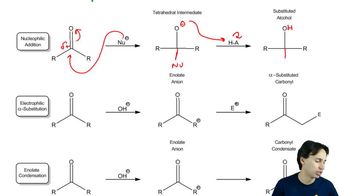
Self-condensation of esters involves the reaction of an ester with itself in the presence of a strong base, leading to the formation of β-keto esters or other products. This reaction typically occurs through a nucleophilic acyl substitution mechanism, where the base deprotonates the ester, allowing it to act as a nucleophile and attack another ester molecule.
Recommended video:
Guided course
05:53
Condensation Reactions

Role of Strong Bases

Strong bases, such as sodium methoxide (NaOCH3) or sodium ethoxide (NaOCH2CH3), are crucial in ester self-condensation as they facilitate the deprotonation of the ester. This creates a reactive alkoxide ion that can initiate nucleophilic attack on another ester molecule, promoting the formation of new carbon-carbon bonds and leading to the desired condensation products.
Recommended video:
Guided course
03:10
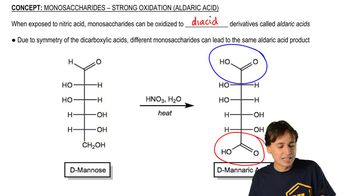
Monosaccharides - Strong Oxidation (Aldaric Acid)

Formation of β-Keto Esters

The self-condensation of esters often results in the formation of β-keto esters, which are characterized by a carbonyl group adjacent to an ester group. This structure is significant in organic synthesis as it can undergo further reactions, such as decarboxylation or hydrolysis, leading to a variety of useful compounds in organic chemistry.
Recommended video:
Guided course
02:39
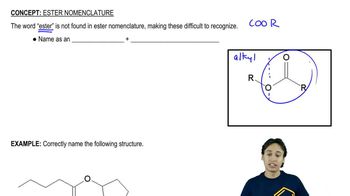
Ester Nomenclature