
Ch. 21 - Carboxylic Acid Derivatives
Wade - Organic Chemistry 9th Edition
Wade9th EditionOrganic ChemistryISBN: 9780135213728Not the one you use?Change textbook
Chapter 21, Problem 63c,d(i)

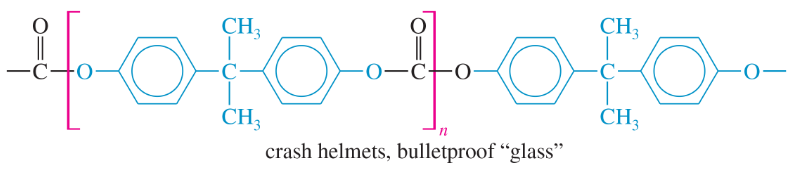
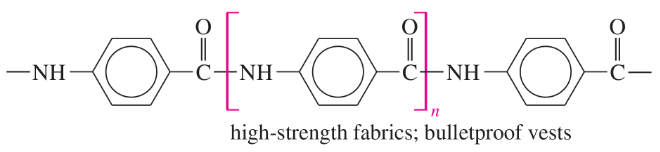
The structures of four useful polymers are shown, together with some of their best-known products. In each case,
(i) determine the kind of polymer (polyamide, polyester, etc.).
(c)
(d)

Verified step by step guidance
1
Step 1: Analyze the first polymer structure (image 1). The repeating unit contains ester functional groups (-COO-) connecting aromatic rings. This indicates that the polymer is a polyester. Polyesters are formed through condensation reactions between diols and dicarboxylic acids.
Step 2: Note the applications of the first polymer, such as crash helmets and bulletproof 'glass'. These applications suggest that the polymer has high strength and durability, which are characteristic properties of polyesters like polycarbonate.
Step 3: Analyze the second polymer structure (image 2). The repeating unit contains amide functional groups (-CONH-) connecting aromatic rings. This indicates that the polymer is a polyamide. Polyamides are formed through condensation reactions between diamines and dicarboxylic acids.
Step 4: Note the applications of the second polymer, such as high-strength fabrics and bulletproof vests. These applications suggest that the polymer has high tensile strength and resistance to impact, which are characteristic properties of polyamides like Kevlar.
Step 5: Summarize the findings: The first polymer is a polyester, likely polycarbonate, used in crash helmets and bulletproof 'glass'. The second polymer is a polyamide, likely Kevlar, used in high-strength fabrics and bulletproof vests.

Verified video answer for a similar problem:

This video solution was recommended by our tutors as helpful for the problem above.
Video duration:
2m
Was this helpful?

Key Concepts

Here are the essential concepts you must grasp in order to answer the question correctly.

Types of Polymers

Polymers can be classified into various types based on their chemical structure and properties. Common categories include polyamides, which contain amide linkages, and polyesters, characterized by ester linkages. Understanding these classifications is essential for identifying the type of polymer in a given structure, as each type has distinct characteristics and applications.
Recommended video:
2:09
Introduction to Polymers Concept 2

Polymerization Process

Polymerization is the chemical process through which monomers are chemically bonded to form a polymer. This can occur through addition (chain-growth) or condensation (step-growth) mechanisms. Recognizing the type of polymerization helps in understanding the formation of the polymer's structure and its resultant properties, which are crucial for applications in materials like crash helmets and bulletproof glass.
Recommended video:
0:58
Anionic Polymerization Concept 1

Applications of Polymers

Different polymers are utilized in various applications based on their mechanical and thermal properties. For instance, polyamides are known for their strength and durability, making them suitable for high-performance fabrics and protective gear. Understanding the relationship between a polymer's structure and its applications is vital for determining its suitability for specific uses, such as in safety equipment.
Recommended video:
1:07
Introduction to Polymers Example 2
Related Practice
Textbook Question

Macrolide antibiotics, including erythromycin and azithromycin (Zithromax®), contain a large ring lactone. One of the largest ever reported is Gargantulide A, the structure of which was determined by the research group of Prof. William Gerwick of the Scripps Institution of Oceanography (Organic Letters, 2015, 17, 1377–1380). Isolated from a Streptomyces bacterium, it kills pathogenic bacteria like MRSA and Clostridium difficile, but it proved too toxic to the test animals to continue further testing.

(a) Identify the lactone that makes this a macrolide structure.

(b) How many rings does this structure contain? How many atoms are in the largest ring?

8
views
Textbook Question

The structures of four useful polymers are shown, together with some of their best-known products. In each case,

(i) Determine the kind of polymer (polyamide, polyester, etc.).

(ii) Draw the structures of the monomers that would be released by complete hydrolysis.

(iii) Suggest what monomers or stable derivatives of the monomers might be used to make these polymers.

(a)

6
views
Textbook Question

In Section 21-16, we saw that Sevin insecticide is made by the reaction of 1-naphthol with methyl isocyanate. A Union Carbide plant in Bhopal, India, once used this process to make Sevin for use as an agricultural insecticide. On December 3,1984, either by accident or by sabotage, a valve was opened that admitted water to a large tank of methyl isocyanate. The pressure and temperature within the tank rose dramatically, and pressure-relief valves opened to keep the tank from bursting. A large quantity of methyl isocyanate rushed out through the pressure-relief valves, and the vapors flowed with the breeze into populated areas, killing about 2500 people and injuring many more.

(a) Write an equation for the reaction that took place in the tank. Explain why the pressure and temperature rose dramatically.

(b) Propose a mechanism for the reaction you wrote in part (a).

8
views
Textbook Question

An unknown compound gives a mass spectrum with a weak molecular ion at m/z 113 and a prominent ion at m/z 68. Its NMR and IR spectra are shown here. Determine the structure, and show how it is consistent with the observed absorptions. Propose a favorable fragmentation to explain the prominent MS peak at m/z 68.

<IMAGE>

1
views
Textbook Question

The structures of four useful polymers are shown, together with some of their best-known products. In each case,

(i) Determine the kind of polymer (polyamide, polyester, etc.).

(ii) Draw the structures of the monomers that would be released by complete hydrolysis.

(iii) Suggest what monomers or stable derivatives of the monomers might be used to make these polymers.

(b)

1
views