Ch. 21 - Carboxylic Acid Derivatives
Wade - Organic Chemistry 9th Edition
Wade9th EditionOrganic ChemistryISBN: 9780135213728Not the one you use?Change textbook
Chapter 21, Problem 71a,b

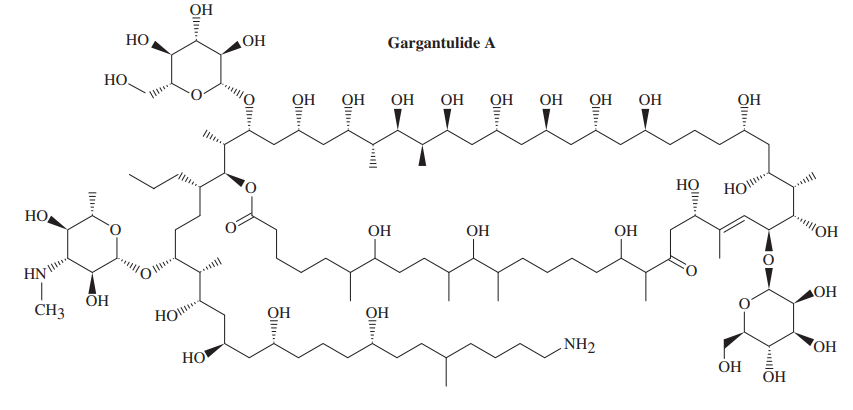
Macrolide antibiotics, including erythromycin and azithromycin (Zithromax®), contain a large ring lactone. One of the largest ever reported is Gargantulide A, the structure of which was determined by the research group of Prof. William Gerwick of the Scripps Institution of Oceanography (Organic Letters, 2015, 17, 1377–1380). Isolated from a Streptomyces bacterium, it kills pathogenic bacteria like MRSA and Clostridium difficile, but it proved too toxic to the test animals to continue further testing.
(a) Identify the lactone that makes this a macrolide structure.
(b) How many rings does this structure contain? How many atoms are in the largest ring?
Chemical structure of Gargantulide A, a macrolide antibiotic with multiple hydroxyl groups and a large ring lactone.

Verified step by step guidance
1
Examine the structure of Gargantulide A provided in the image. A lactone is a cyclic ester, which contains a carbonyl group (C=O) bonded to an oxygen atom within a ring structure. Identify the lactone group in the molecule by locating the ester functional group within a ring.
The term 'macrolide' refers to a large ring lactone. In Gargantulide A, the largest ring containing a lactone group is the macrolide structure. Locate the largest ring in the molecule that contains the lactone functional group.
Count the number of rings present in the structure. Look for all cyclic structures, including the macrolide ring and any other smaller rings present in the molecule.
Determine the number of atoms in the largest ring. To do this, count all the atoms (carbon, oxygen, etc.) that form the perimeter of the macrolide ring.
Summarize the findings: Identify the lactone group that makes this a macrolide structure, state the total number of rings in the molecule, and specify the number of atoms in the largest ring.

Verified video answer for a similar problem:

This video solution was recommended by our tutors as helpful for the problem above.
Video duration:
5m
Was this helpful?

Key Concepts

Here are the essential concepts you must grasp in order to answer the question correctly.

Macrolide Structure

Macrolides are a class of antibiotics characterized by a large lactone ring, typically containing 14 to 16 atoms. The lactone is formed through the esterification of a hydroxy acid, which is crucial for the antibiotic's mechanism of action. Understanding the structure of macrolides, including the specific lactone present in Gargantulide A, is essential for identifying its properties and functions.
Recommended video:
Guided course
03:04
Drawing Resonance Structures

Ring Structure in Organic Chemistry

In organic chemistry, the term 'ring structure' refers to a cyclic arrangement of atoms within a molecule. The number of rings and their sizes can significantly influence the chemical properties and biological activity of a compound. For Gargantulide A, determining the number of rings and the size of the largest ring is vital for understanding its structural complexity and potential interactions with biological targets.
Recommended video:
Guided course
03:49
How to use Organic Chemistry to make Lewis Structures easier.

Antibiotic Mechanism of Action

Antibiotics like macrolides function by inhibiting bacterial growth through various mechanisms, such as blocking protein synthesis. Understanding how Gargantulide A interacts with bacterial cells, particularly its effectiveness against pathogens like MRSA, is crucial for evaluating its potential therapeutic applications. However, the toxicity observed in test animals highlights the importance of balancing efficacy with safety in drug development.
Recommended video:
Guided course
04:32
General Mechanism