Ch. 21 - Carboxylic Acid Derivatives
Wade - Organic Chemistry 9th Edition
Wade9th EditionOrganic ChemistryISBN: 9780135213728Not the one you use?Change textbook
Chapter 21, Problem 28b

Show how you would add a Grignard reagent to an ester or a nitrile to synthesize
(b) heptan-4-ol.

Verified step by step guidance
1
Identify the target molecule, heptan-4-ol, which is a secondary alcohol with seven carbon atoms. This means the Grignard reagent must add to a precursor molecule to form this structure.
Choose the appropriate precursor molecule. For an ester, the Grignard reagent will add twice to form a tertiary alcohol. For a nitrile, the Grignard reagent will add once to form a ketone, which can then be reduced to a secondary alcohol.
For the ester pathway: Select an ester with a three-carbon chain (e.g., ethyl propanoate). React it with a Grignard reagent containing a four-carbon chain (e.g., butylmagnesium bromide, \( \text{C}_4\text{H}_9\text{MgBr} \)). The first addition forms a ketone intermediate, and the second addition forms the tertiary alcohol.
For the nitrile pathway: Select a nitrile with a three-carbon chain (e.g., propanenitrile). React it with the same Grignard reagent (butylmagnesium bromide). This forms a ketone intermediate (heptan-4-one) after hydrolysis. Reduce the ketone to a secondary alcohol using a reducing agent like \( \text{NaBH}_4 \) or \( \text{LiAlH}_4 \).
Ensure proper reaction conditions: For the Grignard reaction, use an anhydrous ether solvent to prevent deactivation of the Grignard reagent. For the reduction step, use appropriate conditions for the chosen reducing agent. Finally, confirm the structure of heptan-4-ol using spectroscopic techniques like \( ^1\text{H NMR} \) or IR spectroscopy.

Verified video answer for a similar problem:

This video solution was recommended by our tutors as helpful for the problem above.
Video duration:
2m
Was this helpful?

Key Concepts

Here are the essential concepts you must grasp in order to answer the question correctly.

Grignard Reagents

Grignard reagents are organomagnesium compounds represented as R-MgX, where R is an organic group and X is a halogen. They are highly reactive nucleophiles that can add to electrophiles, such as carbonyl compounds. In the context of synthesizing alcohols, Grignard reagents can react with esters or nitriles to form alcohols after hydrolysis.
Recommended video:
Guided course
02:12
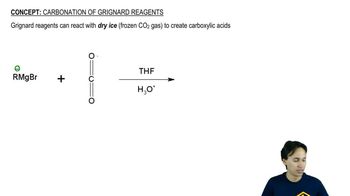
Carbonation of Grignard Reagents

Ester Reactivity

Esters are organic compounds formed from the reaction of an alcohol and a carboxylic acid. They contain a carbonyl group (C=O) adjacent to an ether group (C-O). When a Grignard reagent is added to an ester, it first forms a tetrahedral intermediate, which then leads to the formation of a tertiary alcohol after hydrolysis, making it a key step in synthesizing heptan-4-ol.
Recommended video:
Guided course
02:39
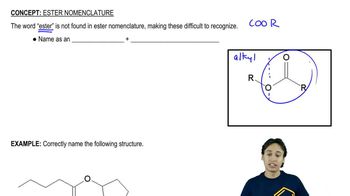
Ester Nomenclature

Nitrile Reactivity

Nitriles are organic compounds containing a cyano group (C≡N) and can be converted into primary amines or alcohols through nucleophilic addition. When a Grignard reagent reacts with a nitrile, it adds to the carbon of the cyano group, forming an intermediate that can be hydrolyzed to yield a primary alcohol. This pathway is also relevant for synthesizing heptan-4-ol.
Recommended video:
Guided course
01:01
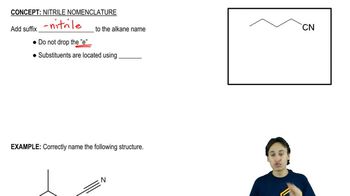
Nitrile Nomenclature