Ch. 21 - Carboxylic Acid Derivatives
Wade - Organic Chemistry 9th Edition
Wade9th EditionOrganic ChemistryISBN: 9780135213728Not the one you use?Change textbook
Chapter 21, Problem 30a

Show how Friedel–Crafts acylation might be used to synthesize the following compounds.
a. acetophenone

Verified step by step guidance
1
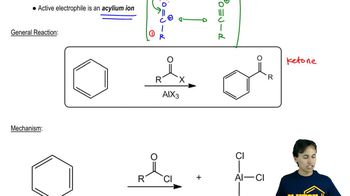
Step 1: Understand the Friedel–Crafts acylation reaction. This reaction involves the introduction of an acyl group (RCO-) into an aromatic ring using an acyl chloride (RCOCl) and a Lewis acid catalyst, typically aluminum chloride (AlCl₃). The aromatic ring acts as the nucleophile, and the acyl group is the electrophile.
Step 2: Identify the target compound, acetophenone. Acetophenone is a ketone with a phenyl group (C₆H₅) attached to a methyl group via a carbonyl group (C=O). The structure can be represented as C₆H₅COCH₃.
Step 3: Choose the appropriate acylating agent. To synthesize acetophenone, the acyl group needed is CH₃CO-. The acylating agent for this reaction would be acetyl chloride (CH₃COCl).
Step 4: Set up the reaction. Combine benzene (C₆H₆) with acetyl chloride (CH₃COCl) in the presence of a Lewis acid catalyst, such as aluminum chloride (AlCl₃). The catalyst facilitates the generation of the acylium ion (CH₃CO⁺), which is the active electrophile in the reaction.
Step 5: Mechanism overview. The acylium ion (CH₃CO⁺) reacts with the benzene ring via electrophilic aromatic substitution. The benzene ring donates electrons to the acylium ion, forming a carbocation intermediate. This intermediate is stabilized by resonance, and the catalyst helps regenerate aromaticity by removing a proton from the ring. The final product is acetophenone (C₆H₅COCH₃).

Verified video answer for a similar problem:

This video solution was recommended by our tutors as helpful for the problem above.
Video duration:
4m
Was this helpful?

Key Concepts

Here are the essential concepts you must grasp in order to answer the question correctly.

Friedel–Crafts Acylation

Friedel–Crafts acylation is an electrophilic aromatic substitution reaction that introduces an acyl group into an aromatic ring. This reaction typically involves the use of an acyl chloride and a Lewis acid catalyst, such as aluminum chloride, to generate the acylium ion, which then reacts with the aromatic compound. The result is a ketone, making this method particularly useful for synthesizing aromatic ketones.
Recommended video:
Guided course
05:20
Friedel-Crafts Acylation

Aromatic Compounds

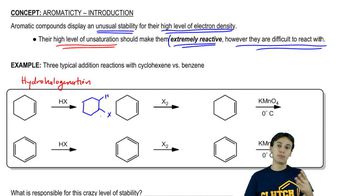
Aromatic compounds are cyclic, planar molecules that follow Huckel's rule, possessing a certain number of π electrons (4n + 2, where n is a non-negative integer). These compounds exhibit unique stability due to resonance, which allows for delocalization of electrons. Understanding the structure and reactivity of aromatic compounds is crucial for predicting the outcomes of reactions like Friedel–Crafts acylation.
Recommended video:
Guided course
08:19
Intro to Aromaticity

Acetophenone Structure

Acetophenone is an aromatic ketone with the chemical formula C8H8O, consisting of a phenyl group (C6H5) attached to an acetyl group (C2H3O). Its structure is essential for understanding how Friedel–Crafts acylation can be employed to synthesize it. The reaction involves the introduction of the acetyl group onto the aromatic ring, resulting in the formation of acetophenone as the final product.
Recommended video:
Guided course
03:04
Drawing Resonance Structures