Ch. 21 - Carboxylic Acid Derivatives
Wade - Organic Chemistry 9th Edition
Wade9th EditionOrganic ChemistryISBN: 9780135213728Not the one you use?Change textbook
Chapter 21, Problem 46

Acid-catalyzed transesterification and Fischer esterification take place by nearly identical mechanisms. Transesterification can also take place by a base-catalyzed mechanism, but all attempts at base-catalyzed Fischer esterification (using –OR″, for example) seem doomed to failure. Explain why Fischer esterification cannot be catalyzed by base.

Verified step by step guidance
1
Fischer esterification involves the reaction of a carboxylic acid (RCOOH) with an alcohol (R'OH) to form an ester (RCOOR') and water. This reaction requires the protonation of the carbonyl oxygen of the carboxylic acid to make the carbonyl carbon more electrophilic, which facilitates nucleophilic attack by the alcohol.
In a base-catalyzed environment, the base (e.g., -OR″) would deprotonate the carboxylic acid, converting it into a carboxylate anion (RCOO⁻). The carboxylate anion is a poor electrophile because the negative charge on the oxygen delocalizes over the carbonyl group, reducing the electrophilicity of the carbonyl carbon.
Since the carbonyl carbon in the carboxylate anion is not sufficiently electrophilic, it cannot effectively react with the alcohol (R'OH) to form the ester. This is a key reason why base-catalyzed Fischer esterification fails.
Additionally, in a basic environment, the alcohol (R'OH) may also be deprotonated to form an alkoxide ion (R'O⁻), which is a strong nucleophile. However, the reaction between the alkoxide ion and the carboxylate anion is not favorable because both species are negatively charged, leading to electrostatic repulsion.
In summary, the failure of base-catalyzed Fischer esterification arises from the inability to generate a sufficiently electrophilic carbonyl carbon and the unfavorable interaction between negatively charged species in the reaction mechanism.

Verified video answer for a similar problem:

This video solution was recommended by our tutors as helpful for the problem above.
Video duration:
4m
Was this helpful?

Key Concepts

Here are the essential concepts you must grasp in order to answer the question correctly.

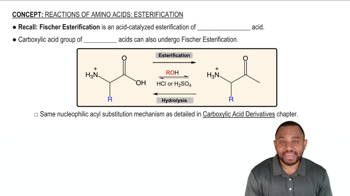
Fischer Esterification

Fischer esterification is a chemical reaction that forms an ester from a carboxylic acid and an alcohol in the presence of an acid catalyst. The reaction involves the nucleophilic attack of the alcohol on the carbonyl carbon of the acid, leading to the formation of a tetrahedral intermediate, which then eliminates water to yield the ester. The acid catalyst enhances the electrophilicity of the carbonyl carbon, facilitating the reaction.
Recommended video:
1:21
Reactions of Amino Acids: Esterification Concept 1

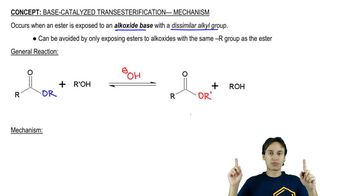
Transesterification

Transesterification is a process where an ester is converted into another ester through the exchange of the alkoxy group. This reaction can occur under both acid and base catalysis. In the acid-catalyzed mechanism, the ester is protonated to increase its electrophilicity, while in the base-catalyzed mechanism, a nucleophile attacks the carbonyl carbon directly, leading to the formation of a new ester and an alcohol.
Recommended video:
Guided course
02:49
General Reaction

Base Catalysis Limitations in Fischer Esterification

Fischer esterification cannot be effectively catalyzed by a base because the reaction requires the protonation of the carbonyl oxygen to enhance electrophilicity. A base would deprotonate the carboxylic acid, reducing its reactivity and preventing the formation of the necessary tetrahedral intermediate. Consequently, the base-catalyzed pathway is not viable for Fischer esterification, as it disrupts the essential protonation step needed for the reaction to proceed.
Recommended video:
2:50
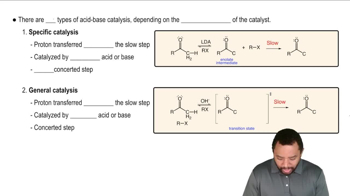
Acid-Base Catalysis Concept 3