
Textbook Question
Rank the compounds in each set in order of increasing acid strength.
(a) CH3CH2COOH, CH3CHBrCOOH, CH3CBr2COOH
2
views

 Verified step by step guidance
 02:49
02:49
 02:01
02:01 1:53
1:53Rank the compounds in each set in order of increasing acid strength.
(a) CH3CH2COOH, CH3CHBrCOOH, CH3CBr2COOH
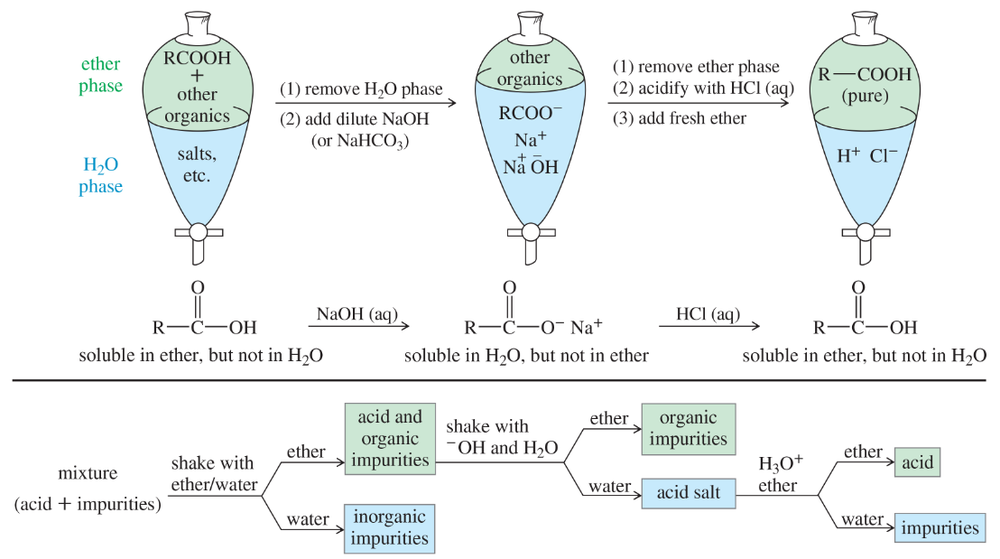
Oxidation of a primary alcohol to an aldehyde usually gives some over-oxidation to the carboxylic acid. Assume you have used PCC to oxidize pentan-1-ol to pentanal.
(a) Show how you would use acid–base extraction to purify the pentanal.
(b) Which of the expected impurities cannot be removed from pentanal by acid–base extractions? How would you remove this impurity?
Phenols are less acidic than carboxylic acids, with values of pKa around 10. Phenols are deprotonated by (and therefore soluble in) solutions of sodium hydroxide but not by solutions of sodium bicarbonate. Explain how you would use extractions to isolate the three pure compounds from a mixture of p-cresol (p-methylphenol), cyclohexanone, and benzoic acid.
Rank the compounds in each set in order of increasing acid strength.
(c)
Rank the compounds in each set in order of increasing acid strength.
(b) CH3CH2CH2CHBrCOOH, CH3CH2CHBrCH2COOH, CH3CHBrCH2CH2COOH
The IR spectrum of trans-oct-2-enoic acid is shown. Point out the spectral characteristics that allow you to tell that this is a carboxylic acid, and show which features lead you to conclude that the acid is unsaturated and conjugated.
<IMAGE>