
Ch. 20 - Carboxylic Acids
Wade - Organic Chemistry 9th Edition
Wade9th EditionOrganic ChemistryISBN: 9780135213728Not the one you use?Change textbook
Chapter 20, Problem 3a

Rank the compounds in each set in order of increasing acid strength.
(a) CH3CH2COOH, CH3CHBrCOOH, CH3CBr2COOH

Verified step by step guidance
1
Identify the functional group responsible for acidity in each compound. In this case, all compounds are carboxylic acids (R-COOH), where the acidic hydrogen is attached to the hydroxyl group (-OH) of the carboxylic acid.
Recognize that the acidity of carboxylic acids is influenced by the electron-withdrawing or electron-donating effects of substituents on the carbon chain. Electron-withdrawing groups stabilize the conjugate base (R-COO⁻) by delocalizing the negative charge, increasing acidity.
Analyze the substituents on the α-carbon (the carbon adjacent to the carboxylic acid group) for each compound: (1) CH₃CH₂COOH has no halogen substituents, (2) CH₃CHBrCOOH has one bromine atom, and (3) CH₃CBr₂COOH has two bromine atoms.
Understand that bromine is an electron-withdrawing group due to its electronegativity. The more bromine atoms present, the stronger the electron-withdrawing effect, which increases the acidity of the compound.
Rank the compounds in order of increasing acid strength based on the number of bromine atoms: CH₃CH₂COOH < CH₃CHBrCOOH < CH₃CBr₂COOH.

Verified video answer for a similar problem:

This video solution was recommended by our tutors as helpful for the problem above.
Video duration:
5m
Was this helpful?

Key Concepts

Here are the essential concepts you must grasp in order to answer the question correctly.

Acid Strength

Acid strength refers to the ability of a compound to donate protons (H+) in a solution. Stronger acids dissociate more completely in water, leading to a higher concentration of H+ ions. The strength of an acid is often influenced by the stability of its conjugate base; the more stable the conjugate base, the stronger the acid.
Recommended video:
Guided course
03:09
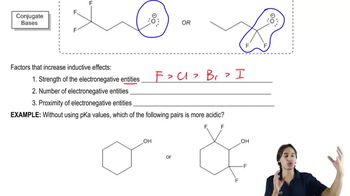
The 3 factors that determine the strength of inductive effects.

Inductive Effect

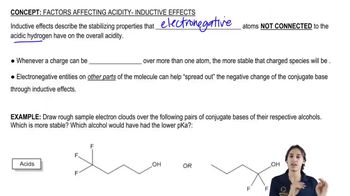
The inductive effect is the electron-withdrawing or electron-donating effect exerted by substituents on a molecule. In carboxylic acids, electronegative substituents (like Br) can stabilize the negative charge on the conjugate base through the inductive effect, thereby increasing acid strength. The greater the number of electronegative substituents, the stronger the acid.
Recommended video:
Guided course
01:47
Understanding the Inductive Effect.

Carboxylic Acids

Carboxylic acids are organic compounds characterized by the presence of a carboxyl group (-COOH). Their acidity is primarily due to the ability of the carboxyl group to release a proton. The structure and substituents attached to the carbon chain can significantly influence their acid strength, making it essential to analyze these factors when ranking their acidity.
Recommended video:
Guided course
04:20
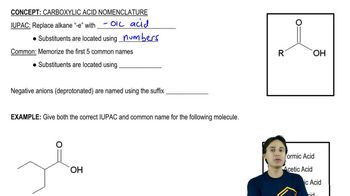
Carboxylic Acids Nomenclature