Ch. 20 - Carboxylic Acids
Wade - Organic Chemistry 9th Edition
Wade9th EditionOrganic ChemistryISBN: 9780135213728Not the one you use?Change textbook
Chapter 20, Problem 36d

Show how you would accomplish the following syntheses efficiently (you may use any necessary reagents).
(d) hexanoic acid → hexanal

Verified step by step guidance
1
Step 1: Recognize that the transformation involves converting a carboxylic acid (hexanoic acid) into an aldehyde (hexanal). This requires reducing the carboxylic acid selectively to the aldehyde without over-reduction to the alcohol.
Step 2: Use a reagent that can selectively reduce carboxylic acids to aldehydes. One common choice is the use of a mild reducing agent such as DIBAL-H (Diisobutylaluminum hydride). DIBAL-H is known for its ability to stop at the aldehyde stage during reduction.
Step 3: Set up the reaction conditions. Add DIBAL-H to hexanoic acid at low temperatures (e.g., -78°C) to ensure controlled reduction. This prevents over-reduction to the alcohol.
Step 4: After the reaction is complete, quench the reaction by adding water or a mild acid to hydrolyze the intermediate and isolate the aldehyde product.
Step 5: Purify the hexanal product using techniques such as distillation or chromatography to ensure the desired compound is obtained in high purity.

Verified video answer for a similar problem:

This video solution was recommended by our tutors as helpful for the problem above.
Video duration:
3m
Was this helpful?

Key Concepts

Here are the essential concepts you must grasp in order to answer the question correctly.

Oxidation-Reduction Reactions

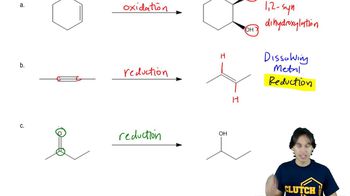
Oxidation-reduction (redox) reactions are fundamental in organic chemistry, involving the transfer of electrons between substances. In the synthesis of hexanal from hexanoic acid, a reduction reaction is necessary, where the carboxylic acid group (-COOH) of hexanoic acid is converted to an aldehyde group (-CHO) in hexanal. Understanding the principles of oxidation states and the role of reducing agents is crucial for this transformation.
Recommended video:
Guided course
00:54
Distinguishing between Oxidation and Reduction

Reagents for Reduction

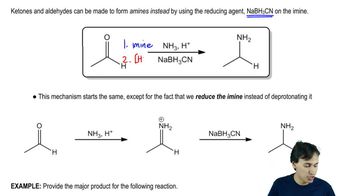
Selecting appropriate reagents is essential for effective organic synthesis. Common reducing agents for converting carboxylic acids to aldehydes include lithium aluminum hydride (LiAlH4) or borane (BH3). These reagents facilitate the reduction process by donating electrons, thus enabling the conversion of the carboxylic acid functional group to an aldehyde while minimizing over-reduction to alcohols.
Recommended video:
Guided course
07:12
Reductive Amination

Functional Group Interconversion

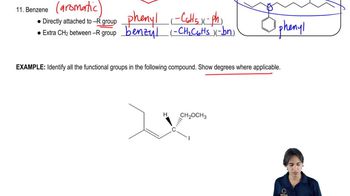
Functional group interconversion refers to the transformation of one functional group into another, which is a key concept in organic synthesis. In this case, converting hexanoic acid (a carboxylic acid) to hexanal (an aldehyde) exemplifies this process. Mastery of functional group interconversions allows chemists to design synthetic pathways and manipulate molecular structures effectively.
Recommended video:
Guided course
02:36
Identifying Functional Groups