Ch. 20 - Carboxylic Acids
Wade - Organic Chemistry 9th Edition
Wade9th EditionOrganic ChemistryISBN: 9780135213728Not the one you use?Change textbook
Chapter 20, Problem 36a

Show how you would accomplish the following syntheses efficiently (you may use any necessary reagents).
(a) trans-1-bromobut-2-ene → trans-pent-3-enoic acid (two ways)

Verified step by step guidance
1
Step 1: Analyze the starting material, trans-1-bromobut-2-ene, and the target molecule, trans-pent-3-enoic acid. Note that the transformation involves extending the carbon chain by one carbon and converting the bromine group into a carboxylic acid functional group.
Step 2: First approach: Perform a Grignard reaction. React trans-1-bromobut-2-ene with magnesium in dry ether to form the Grignard reagent, trans-1-but-2-enylmagnesium bromide. This reagent will allow for nucleophilic attack on a carbonyl compound.
Step 3: React the Grignard reagent with carbon dioxide (CO₂) to form the carboxylate intermediate. This step involves the nucleophilic addition of the Grignard reagent to CO₂, resulting in the formation of trans-pent-3-enoate.
Step 4: Acidify the reaction mixture using dilute HCl to protonate the carboxylate intermediate, yielding trans-pent-3-enoic acid.
Step 5: Second approach: Perform a cyanide substitution reaction. React trans-1-bromobut-2-ene with sodium cyanide (NaCN) in an appropriate solvent (e.g., DMSO) to replace the bromine atom with a nitrile group, forming trans-1-but-2-enenitrile. Hydrolyze the nitrile group under acidic or basic conditions to convert it into a carboxylic acid, yielding trans-pent-3-enoic acid.

Verified video answer for a similar problem:

This video solution was recommended by our tutors as helpful for the problem above.
Video duration:
6m
Was this helpful?

Key Concepts

Here are the essential concepts you must grasp in order to answer the question correctly.

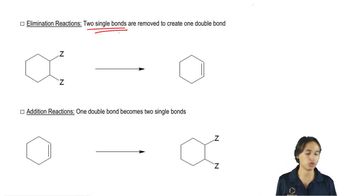
Elimination Reactions

Elimination reactions involve the removal of atoms or groups from a molecule, resulting in the formation of a double bond. In the context of synthesizing trans-pent-3-enoic acid from trans-1-bromobut-2-ene, understanding how to perform elimination reactions, such as E2 or E1 mechanisms, is crucial. These reactions can help generate the necessary alkene intermediates that can be further transformed into the desired carboxylic acid.
Recommended video:
Guided course
00:40
Recognizing Elimination Reactions.

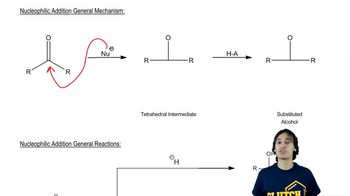
Nucleophilic Addition

Nucleophilic addition is a fundamental reaction in organic chemistry where a nucleophile attacks an electrophilic carbon atom, leading to the formation of new bonds. In the synthesis of trans-pent-3-enoic acid, this concept is essential when considering the addition of a nucleophile to an appropriate carbonyl compound derived from the alkene. This step is critical for converting the alkene into a carboxylic acid through subsequent reactions.
Recommended video:
Guided course
08:27
Nucleophilic Addition

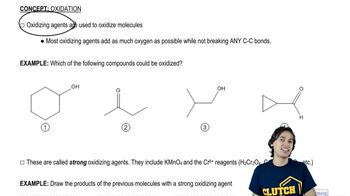
Reagents and Reaction Conditions

The choice of reagents and reaction conditions significantly influences the efficiency and outcome of organic syntheses. For the transformation of trans-1-bromobut-2-ene to trans-pent-3-enoic acid, selecting appropriate reagents such as strong bases for elimination or specific nucleophiles for addition is vital. Additionally, controlling factors like temperature and solvent can optimize yields and selectivity in the synthesis process.
Recommended video: