Ch. 20 - Carboxylic Acids
Wade - Organic Chemistry 9th Edition
Wade9th EditionOrganic ChemistryISBN: 9780135213728Not the one you use?Change textbook
Chapter 20, Problem 1a-d

Draw the structures of the following carboxylic acids.
(a) α-methylbutyric acid
(b) 2-bromobutanoic acid
(c) 4-aminopentanoic acid
(d) cis-4-phenylbut-2-enoic acid

Verified step by step guidance
1
Step 1: Understand the naming conventions of carboxylic acids. The suffix '-oic acid' indicates the presence of a carboxyl group (-COOH). The prefix or substituents describe the additional groups attached to the main carbon chain. Begin by identifying the parent chain and the substituents for each compound.
Step 2: For (a) α-methylbutyric acid: The parent chain is butyric acid (4 carbons with a -COOH group at one end). The term 'α-methyl' indicates a methyl group (-CH₃) attached to the carbon adjacent to the carboxyl group. Draw the structure with the carboxyl group at one end and a methyl group on the α-carbon.
Step 3: For (b) 2-bromobutanoic acid: The parent chain is butanoic acid (4 carbons with a -COOH group at one end). The '2-bromo' indicates a bromine atom attached to the second carbon in the chain. Draw the structure with the carboxyl group at one end and a bromine atom on the second carbon.
Step 4: For (c) 4-aminopentanoic acid: The parent chain is pentanoic acid (5 carbons with a -COOH group at one end). The '4-amino' indicates an amino group (-NH₂) attached to the fourth carbon in the chain. Draw the structure with the carboxyl group at one end and an amino group on the fourth carbon.
Step 5: For (d) cis-4-phenylbut-2-enoic acid: The parent chain is but-2-enoic acid (4 carbons with a -COOH group at one end and a double bond between carbons 2 and 3). The '4-phenyl' indicates a phenyl group (C₆H₅) attached to the fourth carbon. The 'cis' configuration means the substituents on the double bond are on the same side. Draw the structure with the carboxyl group at one end, a double bond between carbons 2 and 3, and a phenyl group on the fourth carbon in the cis configuration.

Verified video answer for a similar problem:

This video solution was recommended by our tutors as helpful for the problem above.
Video duration:
7m
Was this helpful?

Key Concepts

Here are the essential concepts you must grasp in order to answer the question correctly.

Carboxylic Acids

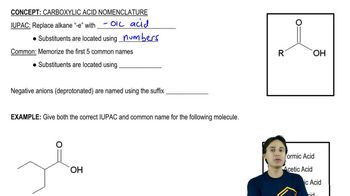
Carboxylic acids are organic compounds characterized by the presence of a carboxyl group (-COOH). This functional group consists of a carbon atom double-bonded to an oxygen atom and single-bonded to a hydroxyl group (-OH). Carboxylic acids are known for their acidic properties and are commonly found in various biological and industrial processes.
Recommended video:
Guided course
04:20
Carboxylic Acids Nomenclature

Nomenclature of Organic Compounds

The nomenclature of organic compounds follows specific rules set by the International Union of Pure and Applied Chemistry (IUPAC). This includes identifying the longest carbon chain, determining the functional groups, and assigning locants to substituents. Understanding these rules is essential for accurately naming and drawing the structures of organic molecules, including carboxylic acids.
Recommended video:
Guided course
01:40
Defining meso compounds.

Structural Isomerism

Structural isomerism occurs when compounds have the same molecular formula but differ in the arrangement of atoms. In the context of the question, different carboxylic acids can exhibit structural isomerism through variations in the position of functional groups or the branching of carbon chains. Recognizing these isomers is crucial for drawing the correct structures of the specified acids.
Recommended video:
Guided course
06:47
Monosaccharides - D and L Isomerism