
Ch. 20 - Carboxylic Acids
Wade - Organic Chemistry 9th Edition
Wade9th EditionOrganic ChemistryISBN: 9780135213728Not the one you use?Change textbook
Chapter 20, Problem 57

Draw the mechanism for the last step in the Kiliani-Fischer synthesis.

Verified step by step guidance
1
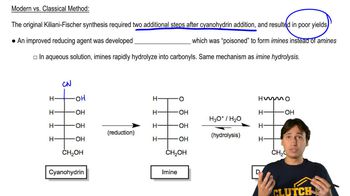
Identify the last step in the Kiliani-Fischer synthesis: The last step involves the conversion of the cyanohydrin intermediate into an aldose sugar through hydrolysis and tautomerization.
Begin by hydrolyzing the cyanohydrin group (-C≡N) into a carboxylic acid (-COOH) using acidic water (H₃O⁺). This step breaks the triple bond and introduces two oxygen atoms to form the carboxylic acid.
Recognize that the carboxylic acid group (-COOH) is then reduced to an aldehyde (-CHO) using a mild reducing agent, such as hydrogen gas (H₂) with a palladium catalyst (Pd/BaSO₄). This step is known as partial reduction.
Understand that the resulting compound is a mixture of two epimeric aldoses (diastereomers) due to the creation of a new stereocenter at the carbon adjacent to the aldehyde group. This is a key feature of the Kiliani-Fischer synthesis.
Draw the full mechanism, showing the hydrolysis of the cyanohydrin, the reduction of the carboxylic acid to an aldehyde, and the formation of the two epimeric aldoses. Use curved arrows to indicate electron movement in each step of the mechanism.

Verified video answer for a similar problem:

This video solution was recommended by our tutors as helpful for the problem above.
Video duration:
7m
Was this helpful?

Key Concepts

Here are the essential concepts you must grasp in order to answer the question correctly.

Kiliani-Fischer Synthesis

The Kiliani-Fischer synthesis is a method for elongating carbon chains in carbohydrates. It involves the addition of a cyanide ion to an aldose sugar, resulting in a new carbon-carbon bond. This process allows for the formation of higher aldehydes from simpler sugars, which is crucial in carbohydrate chemistry.
Recommended video:
Guided course
03:57
Monosaccharides - Kiliani-Fischer

Mechanism of Nucleophilic Addition

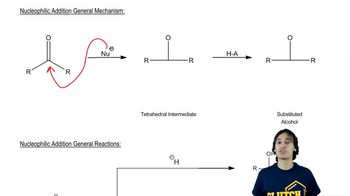
The last step of the Kiliani-Fischer synthesis involves nucleophilic addition, where a nucleophile (cyanide ion) attacks the electrophilic carbon of the carbonyl group in the sugar. This step is essential for forming the new carbon-carbon bond, leading to the production of a cyanohydrin intermediate, which can further undergo hydrolysis to yield the desired sugar derivative.
Recommended video:
Guided course
08:27
Nucleophilic Addition

Stereochemistry in Sugars

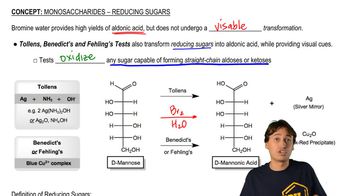
Understanding stereochemistry is vital in the Kiliani-Fischer synthesis, as sugars have multiple chiral centers. The addition of the cyanide ion can lead to the formation of diastereomers, which are different compounds with distinct properties. Recognizing the stereochemical outcomes of the reaction is important for predicting the final structure of the synthesized sugar.
Recommended video:
Guided course
08:42
Reducing Sugars