
Ch. 19 - Amines
Wade - Organic Chemistry 9th Edition
Wade9th EditionOrganic ChemistryISBN: 9780135213728Not the one you use?Change textbook
Chapter 19, Problem 64a

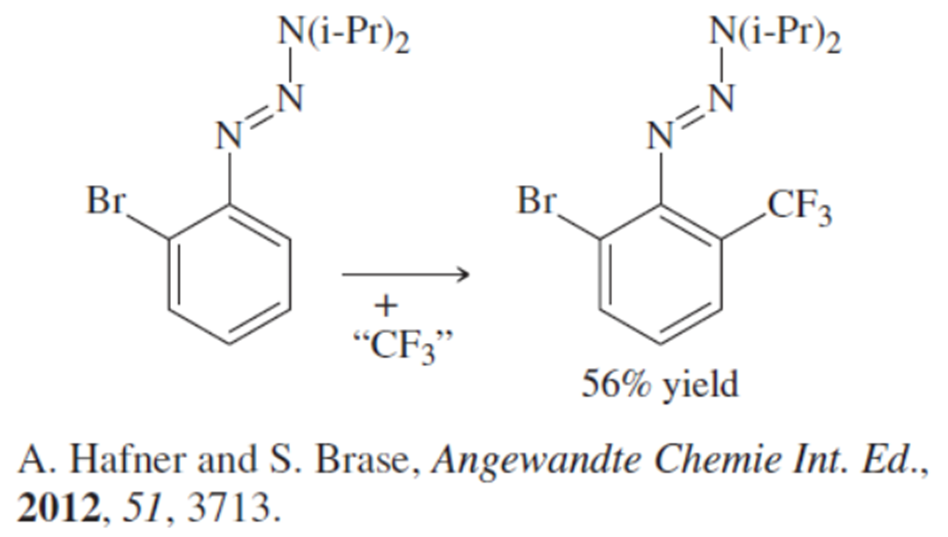
Show how the substituents containing the azo group (N=N) can facilitate both electrophilic and nucleophilic aromatic substitution.
(a)

Verified step by step guidance
1
Understand the structure of the azo group (N=N): The azo group is a functional group characterized by a nitrogen-nitrogen double bond. It is often attached to aromatic rings, and its electronic properties can influence the reactivity of the aromatic system.
Analyze the electronic effects of the azo group: The azo group can act as an electron-withdrawing group due to the delocalization of electrons through resonance and inductive effects. This makes the aromatic ring less electron-rich, which can influence its reactivity in electrophilic and nucleophilic aromatic substitution reactions.
For electrophilic aromatic substitution (EAS): The electron-withdrawing nature of the azo group deactivates the aromatic ring toward electrophilic attack. However, the azo group can direct incoming electrophiles to specific positions on the ring (meta-directing effect) due to its resonance structure. Write out the resonance forms to visualize this effect.
For nucleophilic aromatic substitution (NAS): The electron-withdrawing nature of the azo group increases the susceptibility of the aromatic ring to nucleophilic attack, especially if there are additional electron-withdrawing groups (e.g., nitro groups) on the ring. This facilitates the formation of a Meisenheimer complex, an intermediate in NAS reactions. Identify the positions on the ring where nucleophiles are most likely to attack.
Summarize the dual role of the azo group: The azo group facilitates electrophilic aromatic substitution by directing electrophiles to meta positions, while it facilitates nucleophilic aromatic substitution by making the ring more electrophilic and susceptible to nucleophilic attack. Use resonance structures and reaction mechanisms to illustrate these effects in detail.

Verified video answer for a similar problem:

This video solution was recommended by our tutors as helpful for the problem above.
Video duration:
17m
Was this helpful?

Key Concepts

Here are the essential concepts you must grasp in order to answer the question correctly.

Azo Group (N=N)

The azo group consists of two nitrogen atoms connected by a double bond (N=N). It is a functional group commonly found in organic compounds, particularly azo dyes. The presence of the azo group can significantly influence the reactivity of aromatic compounds, as it can act as both an electron-withdrawing and electron-donating group depending on the substituents attached to the aromatic ring.
Recommended video:
3:06
Synthesis of Amino Acids: N-Phthalimidomalonic Ester Synthesis Concept 1

Electrophilic Aromatic Substitution (EAS)

Electrophilic aromatic substitution is a fundamental reaction in organic chemistry where an electrophile replaces a hydrogen atom on an aromatic ring. The reactivity of the aromatic compound is influenced by the nature of the substituents present. Electron-donating groups, like those attached to an azo group, can enhance the ring's reactivity towards electrophiles, facilitating the substitution process.
Recommended video:

Nucleophilic Aromatic Substitution (NAS)

Nucleophilic aromatic substitution occurs when a nucleophile attacks an aromatic ring, typically at a carbon atom that is bonded to a leaving group. This reaction is more favorable in the presence of electron-withdrawing groups, which stabilize the negative charge in the intermediate formed during the reaction. The azo group can enhance the susceptibility of the aromatic ring to nucleophilic attack by stabilizing the negative charge through resonance.
Recommended video:
Guided course
02:10
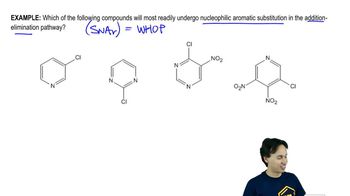
NAS in the addition-elimination pathway
Related Practice
Textbook Question

Reductive amination of aldehydes and ketones is a versatile method for attaching alkyl groups to amines, but the alkyl group is restricted to a 1° or 2° carbon by this method. Prof. Phil Baran of Scripps Research Institute has reported (Science, 2015, 348 (6237), 886–891) a novel way to reduce an aromatic nitro group and add the resulting amine to an alkene so that the aromatic amine is bonded to a 3° carbon—all in a continuous sequence of reactions.

For example:

Predict the products using these starting materials, all of which are reported in this paper.

(c)

(d)

3
views
Textbook Question

Macrolide antibiotics all have large rings (macrocycle) in which an ester makes the ring; a cyclic ester is termed a lactone. One example is erythromycin A, first isolated from soil bacteria in the 1950s. Over time, some pathogenic bacteria have developed resistance to erythromycin by evolving an enzymatic mechanism to cleave the macrocycle at the ketone. To counter this resistance, chemists modified the erythromycin structure to replace the ketone with an amine that the bacteria could not detoxify. This modified antibiotic, azithromycin, trade name Zithromax®, is one of the most prescribed drugs in the world for respiratory infections.

(a) Identify the lactone group in each structure that merits the classification as macrolides.

(b) Two groups are circled. What type of functional group are they? Explain.

1
views
Textbook Question

Show how the substituents containing the azo group (N=N) can facilitate both electrophilic and nucleophilic aromatic substitution.

(b)

1
views
Textbook Question

Basicity depends on availability of an electron pair to bond a proton. Correlate structural effects in these amines with their basicities.

(b) Explain:

1
views
Textbook Question

Basicity depends on availability of an electron pair to bond a proton. Correlate structural effects in these amines with their basicities.

(c) The pKb of this compound is −2.3, making it not only a stronger base than a typical aniline, but even stronger than hydroxide ion. Explain its remarkable basicity.

1
views
Textbook Question

Macrolide antibiotics all have large rings (macrocycle) in which an ester makes the ring; a cyclic ester is termed a lactone. One example is erythromycin A, first isolated from soil bacteria in the 1950s. Over time, some pathogenic bacteria have developed resistance to erythromycin by evolving an enzymatic mechanism to cleave the macrocycle at the ketone. To counter this resistance, chemists modified the erythromycin structure to replace the ketone with an amine that the bacteria could not detoxify. This modified antibiotic, azithromycin, trade name Zithromax®, is one of the most prescribed drugs in the world for respiratory infections.

(c) Identify the ketone in erythromycin targeted by bacteria as the site for detoxification.

(d) Identify the amine in azithromycin. What type of amine is it?

5
views