Ch. 19 - Amines
Wade - Organic Chemistry 9th Edition
Wade9th EditionOrganic ChemistryISBN: 9780135213728Not the one you use?Change textbook
Chapter 19, Problem 61c

Basicity depends on availability of an electron pair to bond a proton. Correlate structural effects in these amines with their basicities.
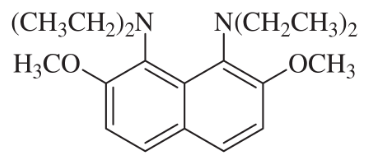
(c) The pKb of this compound is −2.3, making it not only a stronger base than a typical aniline, but even stronger than hydroxide ion. Explain its remarkable basicity.

Verified step by step guidance
1
Step 1: Analyze the structure of the compound provided. The molecule contains two amine groups, each attached to a benzene ring. Additionally, there are two methoxy (-OCH3) groups attached to the benzene rings. The amine groups are diethylamines ((CH3CH2)2N), which are electron-donating groups.
Step 2: Understand the concept of basicity. Basicity depends on the availability of the lone pair of electrons on the nitrogen atom to bond with a proton (H+). Electron-donating groups increase the electron density on the nitrogen atom, making it more available to bond with a proton, thereby increasing basicity.
Step 3: Examine the effect of the methoxy groups (-OCH3). Methoxy groups are electron-donating through resonance and inductive effects. They increase the electron density on the benzene ring, which further enhances the electron-donating ability of the amine groups attached to the ring. This synergistic effect significantly increases the basicity of the compound.
Step 4: Compare the basicity of this compound to typical aniline. In aniline, the lone pair on the nitrogen is partially delocalized into the benzene ring, reducing its availability to bond with a proton. In this compound, the electron-donating effects of the diethylamine groups and methoxy groups prevent delocalization of the nitrogen's lone pair, making it highly available for protonation.
Step 5: Explain the remarkable basicity (pKb = -2.3). The combination of strong electron-donating groups (diethylamine and methoxy) results in an exceptionally high electron density on the nitrogen atoms, making the compound a much stronger base than typical aniline and even stronger than hydroxide ion. This is why the compound exhibits such a low pKb value.

Verified video answer for a similar problem:

This video solution was recommended by our tutors as helpful for the problem above.
Video duration:
3m
Was this helpful?

Key Concepts

Here are the essential concepts you must grasp in order to answer the question correctly.

Basicity and Electron Pair Availability

Basicity in organic chemistry refers to the ability of a compound to accept protons (H+ ions). This property is largely determined by the availability of an electron pair on the atom that can bond with a proton. In amines, the nitrogen atom has a lone pair of electrons that can be donated to form a bond with a proton, making them basic. The more available this electron pair is, the stronger the base.
Recommended video:
2:56
Base Pairing Concept 1

Structural Effects on Basicity

The basicity of amines can be influenced by their molecular structure, including factors such as steric hindrance and electronic effects. For instance, alkyl groups can donate electron density to the nitrogen atom, enhancing its ability to bond with protons. Conversely, electron-withdrawing groups can decrease basicity by stabilizing the lone pair, making it less available for bonding. Understanding these structural effects is crucial for predicting the basicity of different amines.
Recommended video:
Guided course
06:21
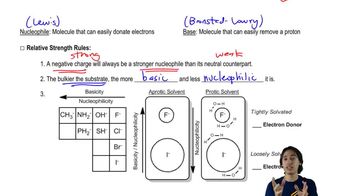
Understanding the difference between basicity and nucleophilicity.

pKb and Basicity Comparison

The pKb value is a quantitative measure of a base's strength, with lower values indicating stronger bases. A pKb of -2.3 suggests that the compound in question is exceptionally basic, even more so than typical bases like aniline or hydroxide ions. This remarkable basicity can be attributed to structural features that enhance electron pair availability, such as resonance stabilization or the presence of strong electron-donating groups, which facilitate protonation.
Recommended video:
Guided course
06:21
Understanding the difference between basicity and nucleophilicity.