Ch. 18 - Ketones and Aldehydes
Wade - Organic Chemistry 9th Edition
Wade9th EditionOrganic ChemistryISBN: 9780135213728Not the one you use?Change textbook
Chapter 18, Problem 23f

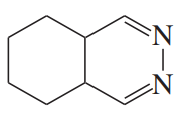
Show what amines and carbonyl compounds combine to give the following derivatives.
(f) Chemical structures illustrating the formation of imines and enamines from amines and carbonyl compounds.

Verified step by step guidance
1
Step 1: Analyze the given structure. The derivative shown is a bicyclic compound containing two nitrogen atoms in a pyrazine ring fused to a cyclohexane ring. This suggests that the compound is formed via a condensation reaction between an amine and a carbonyl compound.
Step 2: Identify the functional groups in the derivative. The pyrazine ring indicates that two nitrogen atoms are incorporated into the structure, likely from amines. The carbonyl groups from the starting materials would have been involved in forming the double bonds in the pyrazine ring.
Step 3: Determine the amines required. To form the pyrazine ring, two primary amines are needed. These amines will contribute the nitrogen atoms to the ring structure.
Step 4: Determine the carbonyl compounds required. The carbonyl compounds must provide the carbon atoms that form the backbone of the pyrazine ring. Typically, aldehydes or ketones are used in such condensation reactions.
Step 5: Combine the amines and carbonyl compounds. The reaction involves the condensation of two equivalents of the amine with two equivalents of the carbonyl compound, followed by cyclization to form the pyrazine ring fused to the cyclohexane ring.

Verified video answer for a similar problem:

This video solution was recommended by our tutors as helpful for the problem above.
Video duration:
2m
Was this helpful?

Key Concepts

Here are the essential concepts you must grasp in order to answer the question correctly.

Amines

Amines are organic compounds derived from ammonia (NH3) by replacing one or more hydrogen atoms with alkyl or aryl groups. They can be classified as primary, secondary, or tertiary based on the number of carbon-containing groups attached to the nitrogen atom. Amines are known for their basicity and nucleophilicity, making them reactive towards electrophiles, such as carbonyl compounds.
Recommended video:
Guided course
07:12
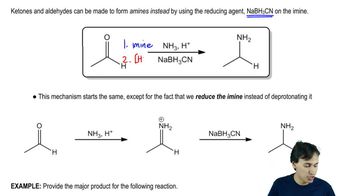
Reductive Amination

Carbonyl Compounds

Carbonyl compounds contain a carbon atom double-bonded to an oxygen atom (C=O). This functional group is characteristic of aldehydes and ketones, which play a significant role in organic reactions. The electrophilic nature of the carbonyl carbon allows it to react with nucleophiles, such as amines, leading to the formation of various derivatives, including imines and enamines.
Recommended video:
Guided course
01:40
Defining meso compounds.

Condensation Reaction

A condensation reaction occurs when two molecules combine to form a larger molecule, with the simultaneous loss of a small molecule, often water. In the context of amines and carbonyl compounds, this reaction typically results in the formation of imines or enamines. Understanding this reaction is crucial for predicting the products formed when amines react with carbonyl compounds.
Recommended video:
Guided course
05:53
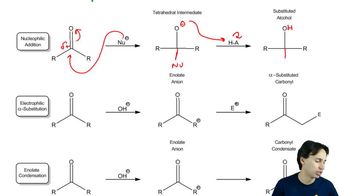
Condensation Reactions