
In the mechanism for acetal hydrolysis shown, the ring oxygen atom was protonated first, the ring was cleaved, and then the methoxy group was lost. The mechanism could also be written to show the methoxy oxygen protonating and cleaving first, followed by ring cleavage. Draw this alternative mechanism.
Ch. 18 - Ketones and Aldehydes
Chapter 18, Problem 26a,b,c
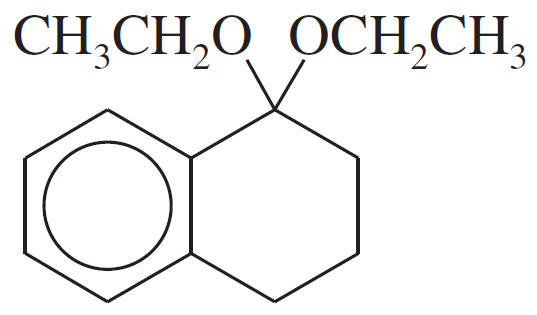
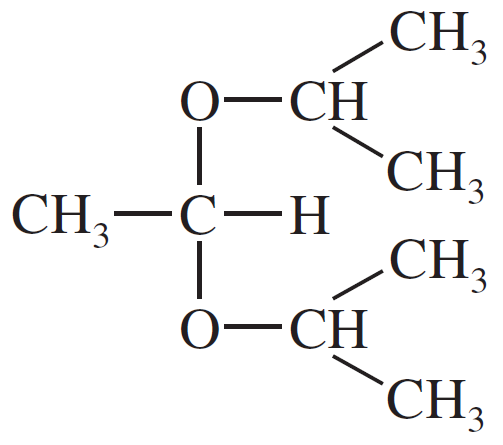
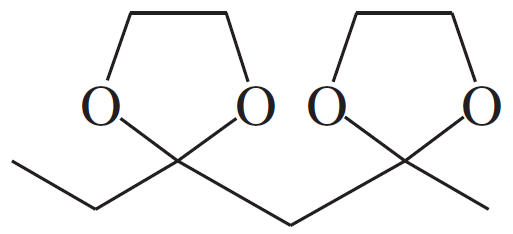
Show what alcohols and carbonyl compounds give the following derivatives.
(a) 
(b) 
(c) 
Verified step by step guidance1
Step 1: Analyze the derivative structures provided in the images. Each derivative corresponds to a reaction between an alcohol and a carbonyl compound. For (a), the structure shows a cyclic acetal formed from a cyclopentane ring with two methoxy groups attached to the same carbon. For (b), the structure shows a ketal with three isopropyl groups attached to two oxygen atoms. For (c), the structure shows a cyclic acetal formed from a cyclohexane ring with two oxygen atoms connected to two additional cyclic structures.
Step 2: Recall the general mechanism for acetal and ketal formation. Acetals and ketals are formed when alcohols react with aldehydes or ketones in the presence of an acid catalyst. The reaction involves nucleophilic attack of the alcohol on the carbonyl carbon, followed by dehydration to form the acetal or ketal.
Step 3: For derivative (a), identify the alcohol and carbonyl compound. The cyclic acetal suggests that the alcohol used is methanol (CH₃OH), and the carbonyl compound is cyclopentanone (a ketone with a five-membered ring). The reaction forms the acetal by adding two methoxy groups to the carbonyl carbon.
Step 4: For derivative (b), identify the alcohol and carbonyl compound. The ketal structure suggests that the alcohol used is isopropanol ((CH₃)₂CHOH), and the carbonyl compound is acetone ((CH₃)₂CO). The reaction forms the ketal by adding two isopropoxy groups to the carbonyl carbon.
Step 5: For derivative (c), identify the alcohol and carbonyl compound. The cyclic acetal structure suggests that the alcohol used is ethylene glycol (HOCH₂CH₂OH), and the carbonyl compound is cyclohexanone (a ketone with a six-membered ring). The reaction forms the acetal by connecting the two hydroxyl groups of ethylene glycol to the carbonyl carbon.

Verified video answer for a similar problem:
This video solution was recommended by our tutors as helpful for the problem above.
Video duration:
7mWas this helpful?
Key Concepts
Here are the essential concepts you must grasp in order to answer the question correctly.
Alcohols
Alcohols are organic compounds characterized by the presence of one or more hydroxyl (-OH) groups attached to a carbon atom. They can undergo various reactions, including dehydration to form alkenes or oxidation to yield carbonyl compounds. Understanding the structure and reactivity of alcohols is crucial for predicting the types of derivatives they can form, such as ethers or esters.
Recommended video:
Guided course
How to name alcohols
Carbonyl Compounds
Carbonyl compounds, which include aldehydes and ketones, contain a carbon atom double-bonded to an oxygen atom (C=O). These compounds are highly reactive and can participate in nucleophilic addition reactions, leading to the formation of various derivatives like imines and enamines. Recognizing the structure and reactivity of carbonyl compounds is essential for understanding their derivatives.
Recommended video:
Guided course
Defining meso compounds.
Imines and Enamines
Imines and enamines are derivatives formed from carbonyl compounds. Imines are produced when a carbonyl compound reacts with an amine, resulting in a C=N bond, while enamines are formed when a carbonyl compound reacts with a secondary amine, leading to a C=C bond adjacent to a nitrogen atom. These derivatives are important in organic synthesis and can serve as intermediates in various chemical reactions.
Recommended video:
Guided course
Enamine Mechanism
Related Practice
Textbook Question
1
views
Textbook Question
Propose a mechanism for the acid-catalyzed reaction of cyclohexanone with ethylene glycol to give cyclohexanone ethylene acetal.
3
views
Textbook Question
Show what amines and carbonyl compounds combine to give the following derivatives.
(f)
2
views
Textbook Question
Propose a mechanism for the acid-catalyzed hydrolysis of cyclohexanone dimethyl acetal.
Textbook Question
Propose a mechanism for the acid-catalyzed hydrolysis of cyclohexanone ethylene acetal.
1
views
Textbook Question
Propose a mechanism for the acid-catalyzed reaction of benzaldehyde with methanol to give benzaldehyde dimethyl acetal.
1
views
