Ch. 18 - Ketones and Aldehydes
Wade - Organic Chemistry 9th Edition
Wade9th EditionOrganic ChemistryISBN: 9780135213728Not the one you use?Change textbook
Chapter 18, Problem 47f

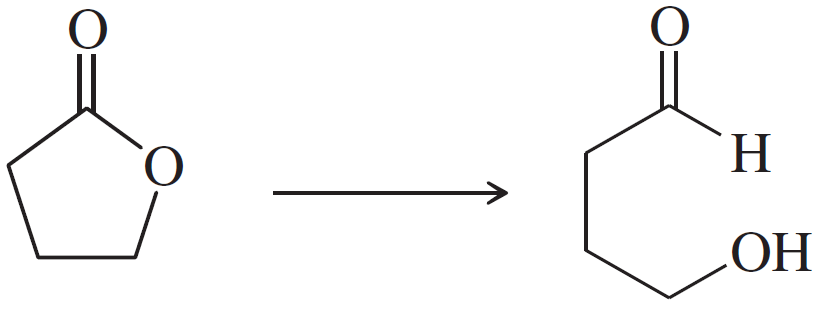
Show how you would accomplish the following synthetic conversions efficiently and in good yield. You may use any necessary additional reagents and solvents.
(f)

Verified step by step guidance
1
Step 1: Analyze the starting material and product. The starting material is a cyclic ester (lactone), and the product is a cyclic ketone with an alcohol group on the adjacent carbon. This suggests a ring-opening reaction followed by reduction and functional group transformation.
Step 2: Perform a nucleophilic ring-opening of the lactone. Use a nucleophile such as ethylene glycol (HOCH2CH2OH) in the presence of a base like sodium hydroxide (NaOH) to open the lactone ring and form a hydroxy acid intermediate.
Step 3: Decarboxylate the hydroxy acid intermediate. Heat the intermediate under acidic conditions to remove the carboxylic acid group and form the cyclic ketone structure.
Step 4: Introduce the alcohol group on the adjacent carbon. Use a Grignard reagent (e.g., CH3MgBr) to add a methyl group to the ketone, followed by hydrolysis to form the secondary alcohol.
Step 5: Purify the product. Use techniques such as recrystallization or distillation to isolate the desired cyclic ketone with the alcohol group in good yield.

Verified video answer for a similar problem:

This video solution was recommended by our tutors as helpful for the problem above.
Video duration:
8m
Was this helpful?

Key Concepts

Here are the essential concepts you must grasp in order to answer the question correctly.

Cyclic Ketones

Cyclic ketones are organic compounds characterized by a carbonyl group (C=O) attached to a carbon atom within a ring structure. Their reactivity is influenced by the ring strain and the presence of substituents. Understanding the structure and reactivity of cyclic ketones is crucial for predicting the outcomes of synthetic transformations, such as reduction reactions.
Recommended video:
Guided course
02:27
Name the ketone

DIBAL-H (Diisobutylaluminum Hydride)

DIBAL-H is a selective reducing agent commonly used in organic synthesis to convert esters and ketones to aldehydes and alcohols. It operates under mild conditions and is particularly effective for reducing cyclic ketones to alcohols without over-reduction. Knowledge of DIBAL-H's mechanism and selectivity is essential for planning efficient synthetic routes.
Recommended video:
Guided course
02:10
DIBAL-H on Esters and Nitriles

Reduction Reactions

Reduction reactions involve the gain of electrons or hydrogen, leading to a decrease in oxidation state. In organic chemistry, these reactions often convert carbonyl compounds to alcohols. Understanding the principles of reduction, including the choice of reducing agents and reaction conditions, is vital for achieving high yields in synthetic conversions.
Recommended video:
Guided course
07:12
Reductive Amination