Ch. 18 - Ketones and Aldehydes
Wade - Organic Chemistry 9th Edition
Wade9th EditionOrganic ChemistryISBN: 9780135213728Not the one you use?Change textbook
Chapter 18, Problem 47e

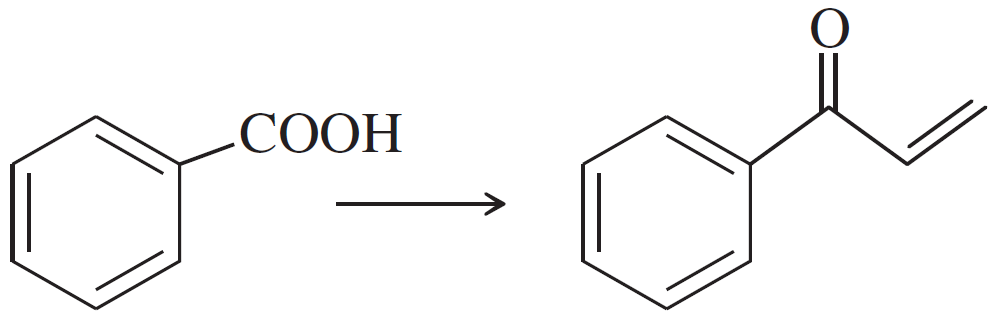
Show how you would accomplish the following synthetic conversions efficiently and in good yield. You may use any necessary additional reagents and solvents.
(e)

Verified step by step guidance
1
Step 1: Analyze the transformation. The starting material is acetic acid (CH3COOH), and the product is methyl vinyl ketone (CH3COCH=CH2). This involves converting a carboxylic acid into an α,β-unsaturated ketone.
Step 2: Convert the carboxylic acid into an acid chloride. Use thionyl chloride (SOCl2) or oxalyl chloride (COCl2) in the presence of a base like pyridine to replace the hydroxyl group (-OH) with a chlorine atom, forming acetyl chloride (CH3COCl).
Step 3: Perform a reaction to introduce the vinyl group. Use a Wittig reaction or a similar method to form the double bond. For example, react acetyl chloride with a phosphorus ylide (Ph3P=CH2) to generate the α,β-unsaturated ketone.
Step 4: Ensure the reaction conditions are optimized for good yield. Use an appropriate solvent like dichloromethane (CH2Cl2) and maintain the reaction temperature to avoid side reactions.
Step 5: Purify the product. Use distillation or chromatography to isolate methyl vinyl ketone and confirm its structure using spectroscopic techniques like NMR or IR.

Verified video answer for a similar problem:

This video solution was recommended by our tutors as helpful for the problem above.
Video duration:
7m
Was this helpful?

Key Concepts

Here are the essential concepts you must grasp in order to answer the question correctly.

Aldehyde Reactivity

Aldehydes are highly reactive carbonyl compounds characterized by the presence of a carbonyl group (C=O) bonded to at least one hydrogen atom. This reactivity allows them to undergo various nucleophilic addition reactions, including the formation of imines when reacted with primary amines. Understanding the electrophilic nature of the carbonyl carbon is crucial for predicting the outcome of reactions involving aldehydes.
Recommended video:
Guided course
01:34
Name the aldehyde

Imine Formation

Imine formation occurs when an aldehyde or ketone reacts with a primary amine, resulting in the condensation of the carbonyl compound and the amine to form an imine (C=N). This reaction typically involves the nucleophilic attack of the amine on the carbonyl carbon, followed by the elimination of water. The stability and reactivity of imines make them important intermediates in organic synthesis.
Recommended video:
Guided course
06:23
Imine Mechanism

Reaction Conditions and Catalysts

The efficiency and yield of the conversion from aldehyde to imine can be influenced by various reaction conditions, including temperature, solvent choice, and the presence of catalysts. Acidic or basic conditions can facilitate the reaction by protonating the carbonyl oxygen or deprotonating the amine, respectively. Selecting appropriate solvents and reagents is essential for optimizing the reaction pathway and achieving high yields.
Recommended video:
2:10
Introduction to Catalysis Concept 1