Ch. 18 - Ketones and Aldehydes
Wade - Organic Chemistry 9th Edition
Wade9th EditionOrganic ChemistryISBN: 9780135213728Not the one you use?Change textbook
Chapter 18, Problem 9c,d

Show how the following transformations may be accomplished in good yield. You may use any additional reagents that are needed.
(c) benzoic acid → phenyl cyclopentyl ketone
(d) 1-bromohept-2-ene → oct-3-enal

Verified step by step guidance
1
For part (c), benzoic acid → phenyl cyclopentyl ketone: Start by converting benzoic acid to benzoyl chloride using thionyl chloride (SOCl₂). This reaction replaces the hydroxyl group (-OH) of the carboxylic acid with a chlorine atom, forming benzoyl chloride.
React benzoyl chloride with cyclopentane in the presence of a Friedel-Crafts acylation catalyst, such as aluminum chloride (AlCl₃). This introduces the cyclopentyl group to the benzoyl chloride, forming phenyl cyclopentyl ketone.
For part (d), 1-bromohept-2-ene → oct-3-enal: Begin by performing a Grignard reaction. React 1-bromohept-2-ene with magnesium (Mg) in an ether solvent to form the Grignard reagent, hept-2-enylmagnesium bromide.
React the Grignard reagent with formaldehyde (HCHO) to introduce an additional carbon atom. This step forms an alcohol intermediate, specifically oct-3-en-1-ol.
Oxidize the alcohol intermediate (oct-3-en-1-ol) to the corresponding aldehyde (oct-3-enal) using a mild oxidizing agent such as pyridinium chlorochromate (PCC). This completes the transformation.

Verified video answer for a similar problem:

This video solution was recommended by our tutors as helpful for the problem above.
Video duration:
3m
Was this helpful?

Key Concepts

Here are the essential concepts you must grasp in order to answer the question correctly.

Reactivity of Carboxylic Acids

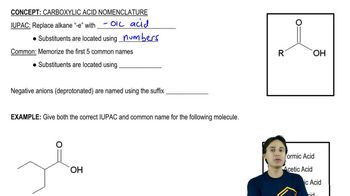
Benzoic acid is a carboxylic acid that can undergo various transformations, including acylation reactions. Understanding the reactivity of carboxylic acids is crucial for converting them into ketones. In this case, benzoic acid can be transformed into phenyl cyclopentyl ketone through a Friedel-Crafts acylation or similar reaction, where a suitable acylating agent is used.
Recommended video:
Guided course
04:20
Carboxylic Acids Nomenclature

Alkene Reactivity and Rearrangement

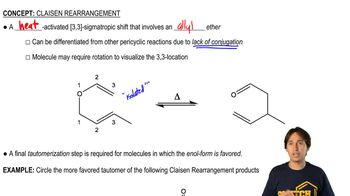
1-bromohept-2-ene is an alkene that can undergo various reactions, including elimination and rearrangement. The transformation to oct-3-enal involves a reaction that may include a hydroboration-oxidation sequence or a similar pathway that allows for the formation of the aldehyde. Understanding the mechanisms of alkene reactions is essential for predicting the products of such transformations.
Recommended video:
Guided course
06:08
Definition of Claisen Rearrangement

Synthetic Pathways and Reagents

In organic synthesis, selecting the appropriate reagents and understanding the synthetic pathways is vital for achieving desired transformations. For both transformations mentioned, knowledge of reagents such as acyl chlorides, Grignard reagents, or specific catalysts is necessary. This concept emphasizes the importance of strategic planning in organic synthesis to ensure high yields and selectivity.
Recommended video:
2:13
Energy Production In Biochemical Pathways Concept 1