Ch. 18 - Ketones and Aldehydes
Wade - Organic Chemistry 9th Edition
Wade9th EditionOrganic ChemistryISBN: 9780135213728Not the one you use?Change textbook
Chapter 18, Problem 10a,b

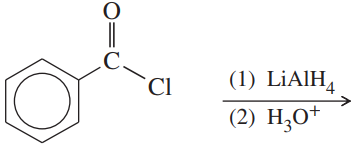
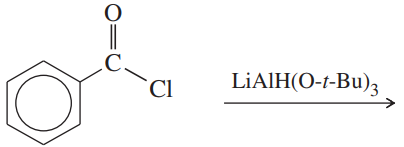
Predict the products of the following reactions:
(a) Chemical reaction diagram showing a carbonyl compound with a chlorine atom, and reduction steps using LiAlH4 and H3O+.
(b) Chemical structure of a carbonyl compound with a chlorine atom, alongside a reducing agent, LiAlH(O-t-Bu)3.

Verified step by step guidance
1
Step 1: Analyze the reactants and reagents in each reaction. In both cases, the starting material is benzoyl chloride (C6H5COCl), which contains a benzene ring attached to a carbonyl group and a chlorine atom. The reagents differ between the two reactions.
Step 2: For reaction (a), the reagents are (1) LiAlH4 and (2) H3O+. Lithium aluminum hydride (LiAlH4) is a strong reducing agent that reduces acyl chlorides to primary alcohols. The H3O+ step is used to protonate the intermediate formed during the reduction.
Step 3: For reaction (b), the reagent is LiAlH(O-t-Bu)3, which is a bulky reducing agent. This reagent selectively reduces acyl chlorides to aldehydes instead of further reducing them to alcohols due to steric hindrance from the bulky tert-butoxy groups.
Step 4: Predict the product for reaction (a). The acyl chloride (C6H5COCl) will be reduced by LiAlH4 to form benzyl alcohol (C6H5CH2OH) after protonation with H3O+.
Step 5: Predict the product for reaction (b). The acyl chloride (C6H5COCl) will be reduced by LiAlH(O-t-Bu)3 to form benzaldehyde (C6H5CHO) due to the selective reduction to an aldehyde.

Verified video answer for a similar problem:

This video solution was recommended by our tutors as helpful for the problem above.
Video duration:
2m
Was this helpful?

Key Concepts

Here are the essential concepts you must grasp in order to answer the question correctly.

Reaction Mechanisms

Understanding reaction mechanisms is crucial in organic chemistry as they describe the step-by-step process by which reactants transform into products. This includes identifying intermediates, transition states, and the movement of electrons. A clear grasp of mechanisms helps predict the products of reactions based on the types of reagents and conditions involved.
Recommended video:
Guided course
02:16
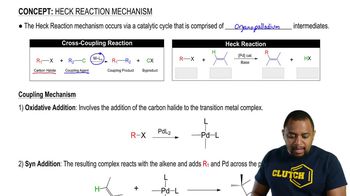
Heck Reaction Mechanism

Functional Groups

Functional groups are specific groups of atoms within molecules that are responsible for the characteristic chemical reactions of those molecules. Recognizing functional groups allows chemists to predict how different compounds will react and what products will form. This knowledge is essential for analyzing organic reactions and understanding their outcomes.
Recommended video:
Guided course
02:36
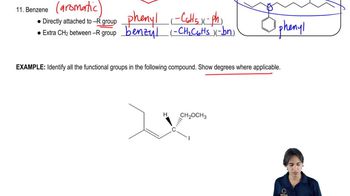
Identifying Functional Groups

Stereochemistry

Stereochemistry involves the study of the spatial arrangement of atoms in molecules and how this affects their chemical behavior. It is important for predicting the products of reactions, especially in cases where chirality or geometric isomerism is involved. Understanding stereochemical principles helps in determining the specific configurations of products formed in reactions.
Recommended video:
1:38
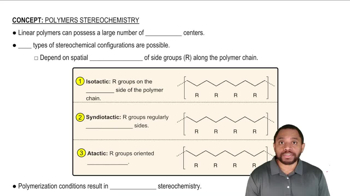
Polymer Stereochemistry Concept 1