Ch. 18 - Ketones and Aldehydes
Wade - Organic Chemistry 9th Edition
Wade9th EditionOrganic ChemistryISBN: 9780135213728Not the one you use?Change textbook
Chapter 18, Problem 37b

Draw structures of the following derivatives.
(b) the semicarbazone of cyclobutanone

Verified step by step guidance
1
Understand the problem: A semicarbazone is a derivative formed by the reaction of a ketone or aldehyde with semicarbazide. Cyclobutanone is a cyclic ketone with a four-membered ring. The goal is to draw the structure of the semicarbazone derivative of cyclobutanone.
Recall the reaction mechanism: Semicarbazide (NH2-NH-C(=O)-NH2) reacts with the carbonyl group (C=O) of the ketone. The reaction involves nucleophilic attack by the -NH2 group of semicarbazide on the carbonyl carbon, followed by the elimination of water (H2O).
Draw the structure of cyclobutanone: Cyclobutanone consists of a four-membered ring with a ketone group (C=O) attached to one of the carbons in the ring.
Combine the structures: Replace the oxygen atom of the carbonyl group in cyclobutanone with the semicarbazone group (-NH-N=C). The resulting structure will have the semicarbazone group attached to the four-membered ring.
Verify the structure: Ensure that the semicarbazone derivative has the correct connectivity, with the semicarbazone group (-NH-N=C) properly bonded to the carbon that was originally part of the carbonyl group in cyclobutanone.

Verified video answer for a similar problem:

This video solution was recommended by our tutors as helpful for the problem above.
Video duration:
3m
Was this helpful?

Key Concepts

Here are the essential concepts you must grasp in order to answer the question correctly.

Semicarbazone Formation

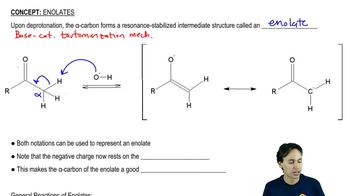
Semicarbazones are formed by the reaction of carbonyl compounds, such as ketones and aldehydes, with semicarbazide. This reaction involves nucleophilic addition where the nitrogen of the semicarbazide attacks the carbonyl carbon, followed by dehydration to form a double bond between the carbon and nitrogen. Understanding this process is crucial for drawing the correct structure of the semicarbazone derivative.
Recommended video:
Guided course
02:26
Formation of Enolates

Cyclobutanone Structure

Cyclobutanone is a cyclic ketone with a four-membered ring structure containing a carbonyl group (C=O). Its unique ring strain and geometry influence its reactivity and the types of derivatives it can form. Recognizing the structure of cyclobutanone is essential for accurately depicting its semicarbazone derivative.
Recommended video:
Guided course
03:04
Drawing Resonance Structures

Functional Group Interconversion

Functional group interconversion refers to the transformation of one functional group into another during chemical reactions. In the case of semicarbazone formation, the carbonyl group of cyclobutanone is converted into an imine-like structure. This concept is important for understanding how different functional groups can be manipulated to create new compounds in organic synthesis.
Recommended video:
Guided course
02:36
Identifying Functional Groups