Ch. 18 - Ketones and Aldehydes
Wade - Organic Chemistry 9th Edition
Wade9th EditionOrganic ChemistryISBN: 9780135213728Not the one you use?Change textbook
Chapter 18, Problem 37a

Draw structures of the following derivatives.
(a) the 2,4-dinitrophenylhydrazone of benzaldehyde

Verified step by step guidance
1
Step 1: Understand the reaction. The 2,4-dinitrophenylhydrazone derivative is formed by the reaction of benzaldehyde with 2,4-dinitrophenylhydrazine. This is a condensation reaction where the hydrazine reacts with the carbonyl group of benzaldehyde to form a hydrazone.
Step 2: Identify the functional groups. Benzaldehyde contains an aldehyde group (-CHO) attached to a benzene ring. 2,4-dinitrophenylhydrazine contains a hydrazine group (-NH-NH2) and two nitro groups (-NO2) at the 2 and 4 positions of the benzene ring.
Step 3: Write the reaction mechanism. The aldehyde group of benzaldehyde undergoes nucleophilic attack by the hydrazine group of 2,4-dinitrophenylhydrazine. This leads to the formation of a hydrazone bond (-C=N-NH-) and the elimination of water.
Step 4: Draw the structure of the product. The product will consist of the benzene ring of benzaldehyde connected to the hydrazone group (-C=N-NH-) and the benzene ring of 2,4-dinitrophenylhydrazine, which has nitro groups at the 2 and 4 positions.
Step 5: Verify the structure. Ensure that the connectivity of atoms is correct, the hydrazone bond is properly formed, and the nitro groups are correctly positioned on the benzene ring of 2,4-dinitrophenylhydrazine.

Verified video answer for a similar problem:

This video solution was recommended by our tutors as helpful for the problem above.
Video duration:
4m
Was this helpful?

Key Concepts

Here are the essential concepts you must grasp in order to answer the question correctly.

Dinitrophenylhydrazone Formation

Dinitrophenylhydrazones are formed through the reaction of hydrazine derivatives with carbonyl compounds, such as aldehydes and ketones. In this process, the carbonyl group (C=O) reacts with the hydrazine, leading to the formation of a hydrazone. The presence of two nitro groups on the phenyl ring enhances the electrophilicity of the carbonyl carbon, facilitating the reaction.
Recommended video:
Guided course
02:26
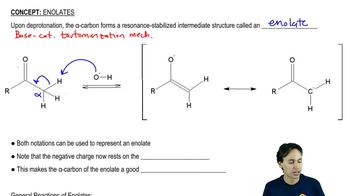
Formation of Enolates

Benzaldehyde Structure

Benzaldehyde is an aromatic aldehyde with the chemical formula C7H6O, characterized by a benzene ring attached to a formyl group (-CHO). Its structure consists of a six-membered carbon ring with alternating double bonds, and the aldehyde functional group is located at one end of the ring. Understanding its structure is crucial for predicting the reactivity and the products formed during the reaction with dinitrophenylhydrazine.
Recommended video:
Guided course
03:04
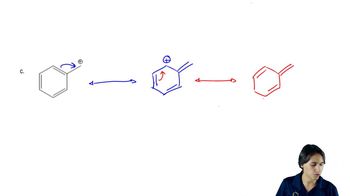
Drawing Resonance Structures

Nucleophilic Addition

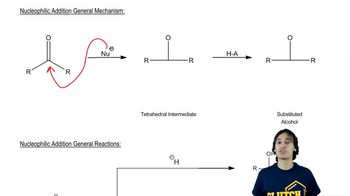
Nucleophilic addition is a fundamental reaction mechanism in organic chemistry where a nucleophile attacks an electrophilic carbon atom, typically found in carbonyl compounds. In the case of benzaldehyde reacting with dinitrophenylhydrazine, the nitrogen atom of the hydrazine acts as a nucleophile, attacking the electrophilic carbon of the carbonyl group. This reaction leads to the formation of a new bond and the eventual production of the dinitrophenylhydrazone derivative.
Recommended video:
Guided course
08:27
Nucleophilic Addition