
Ch. 17 - Reactions of Aromatic Compounds
Wade - Organic Chemistry 9th Edition
Wade9th EditionOrganic ChemistryISBN: 9780135213728Not the one you use?Change textbook
Chapter 17, Problem 63

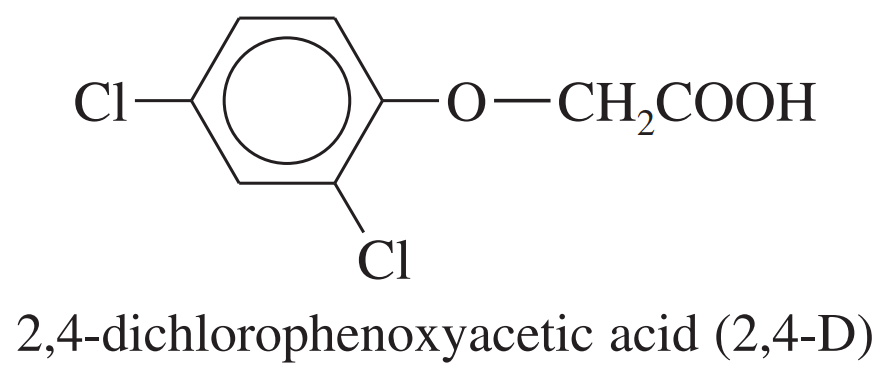
The most common selective herbicide for killing broadleaf weeds is 2,4-dichlorophenoxyacetic acid (2,4-D). Show how you would synthesize 2,4-D from benzene, chloroacetic acid (ClCH2COOH), and any necessary reagents and solvents.

Verified step by step guidance
1
Step 1: Begin with benzene as the starting material. Perform a chlorination reaction using Cl2 and FeCl3 as a catalyst to introduce a chlorine atom onto the benzene ring, forming chlorobenzene. This is an electrophilic aromatic substitution reaction.
Step 2: Introduce a second chlorine atom at the para position relative to the first chlorine. This can be achieved by performing another chlorination reaction with Cl2 and FeCl3. The para position is favored due to the electron-withdrawing effect of the first chlorine atom.
Step 3: Perform a Friedel-Crafts acylation reaction to introduce a carboxylic acid group onto the benzene ring. Use chloroacetic acid (ClCH2COOH) and AlCl3 as a catalyst. The reaction will result in the formation of 2,4-dichlorophenylacetic acid.
Step 4: Oxidize the methyl group of the acetic acid side chain to a carboxylic acid group. This can be achieved using an oxidizing agent such as KMnO4 or CrO3 in acidic or basic conditions, converting the side chain into the desired acetic acid group.
Step 5: Purify the final product, 2,4-dichlorophenoxyacetic acid (2,4-D), using recrystallization or another appropriate purification technique to ensure the product is free of impurities.

Verified video answer for a similar problem:

This video solution was recommended by our tutors as helpful for the problem above.
Video duration:
8m
Was this helpful?

Key Concepts

Here are the essential concepts you must grasp in order to answer the question correctly.

Electrophilic Aromatic Substitution

Electrophilic aromatic substitution (EAS) is a fundamental reaction in organic chemistry where an electrophile replaces a hydrogen atom on an aromatic ring. In the synthesis of 2,4-D, benzene undergoes EAS to introduce a substituent, such as a chloro group, which is essential for further functionalization. Understanding EAS mechanisms, including the role of catalysts and reaction conditions, is crucial for designing the synthesis pathway.
Recommended video:

Carboxylic Acid Derivatives

Carboxylic acid derivatives, such as acyl chlorides and esters, are important in organic synthesis due to their reactivity. Chloroacetic acid, a derivative of acetic acid, can be used to introduce the carboxylic acid functional group in 2,4-D. Recognizing how these derivatives can be transformed and their reactivity patterns is essential for constructing the desired compound from simpler starting materials.
Recommended video:
Guided course
03:50
Intro to Carboxylic Acid Derivatives

Synthetic Pathway Design

Synthetic pathway design involves planning a series of chemical reactions to construct a target molecule from available starting materials. In the case of synthesizing 2,4-D, one must consider the order of reactions, the choice of reagents, and the conditions required for each step. A well-thought-out synthetic route ensures efficient conversion of reactants to the desired product while minimizing side reactions and maximizing yield.
Recommended video:
2:13
Energy Production In Biochemical Pathways Concept 1
Related Practice
Textbook Question

Furan undergoes electrophilic aromatic substitution more readily than benzene; mild reagents and conditions are sufficient. For example, furan reacts with bromine to give 2-bromofuran.

a. Propose mechanisms for the bromination of furan at the 2-position and at the 3-position. Draw the resonance forms of each sigma complex, and compare their stabilities.

3
views
Textbook Question

Furan undergoes electrophilic aromatic substitution more readily than benzene; mild reagents and conditions are sufficient. For example, furan reacts with bromine to give 2-bromofuran.

b. Explain why furan undergoes bromination (and other electrophilic aromatic substitutions) primarily at the 2-position.

Textbook Question

Electrophilic aromatic substitution usually occurs at the 1-position of naphthalene, also called the 1-position. Predict the major products of the reactions of naphthalene with the following reagents.

(e) cyclohexanol and BF3

4
views
Textbook Question

Electrophilic aromatic substitution usually occurs at the 1-position of naphthalene, also called the a position. Predict the major products of the reactions of naphthalene with the following reagents.

(d) isobutylene and HF

Textbook Question

Electrophilic aromatic substitution usually occurs at the 1-position of naphthalene, also called the a position. Predict the major products of the reactions of naphthalene with the following reagents.

(a) HNO3, H2SO4

(b) Br2, FeBr3

(c) CH3CH2COCl, AlCl3

2
views
Textbook Question

(a) Draw the three isomers of benzenedicarboxylic acid.

(b) The isomers have melting points of 210 °C, 343 °C, and 427 °C. Nitration of the isomers at all possible positions was once used to determine their structures. The isomer that melts at 210 °C gives two mononitro isomers. The isomer that melts at 343 °C gives three mononitro isomers. The isomer that melts at 427 °C gives only one mononitro isomer. Show which isomer has which melting point.

1
views