
The most common selective herbicide for killing broadleaf weeds is 2,4-dichlorophenoxyacetic acid (2,4-D). Show how you would synthesize 2,4-D from benzene, chloroacetic acid (ClCH2COOH), and any necessary reagents and solvents.
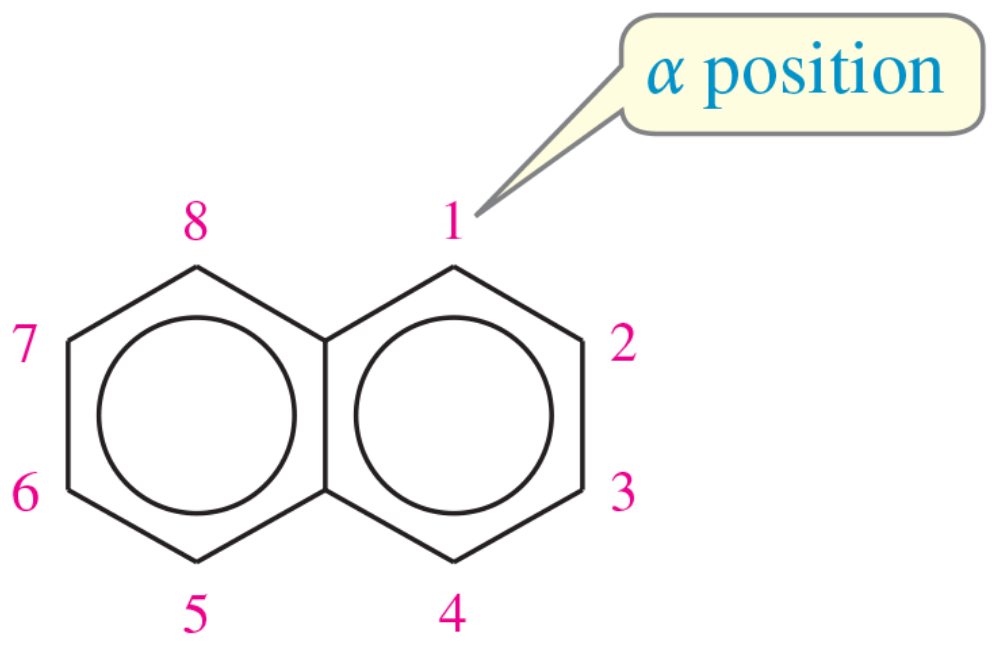
Electrophilic aromatic substitution usually occurs at the 1-position of naphthalene, also called the a position. Predict the major products of the reactions of naphthalene with the following reagents.

(a) HNO3, H2SO4
(b) Br2, FeBr3
(c) CH3CH2COCl, AlCl3
Verified step by step guidance
Verified video answer for a similar problem:
Key Concepts
Electrophilic Aromatic Substitution (EAS)
Naphthalene Structure and Reactivity
Reagents in Electrophilic Substitution
Electrophilic aromatic substitution usually occurs at the 1-position of naphthalene, also called the 1-position. Predict the major products of the reactions of naphthalene with the following reagents.
(e) cyclohexanol and BF3
The following compound reacts with a hot, concentrated solution of NaOH (in a sealed tube) to give a mixture of two products. Propose structures for these products, and give a mechanism to account for their formation.
Electrophilic aromatic substitution usually occurs at the 1-position of naphthalene, also called the a position. Predict the major products of the reactions of naphthalene with the following reagents.
(d) isobutylene and HF
α-Tetralone undergoes Birch reduction to give an excellent yield of a single product. Predict the structure of the product, and propose a mechanism for its formation.
Show the products you expect when each compound reacts with NBS with light shining on the reaction.
(d)
