Ch. 17 - Reactions of Aromatic Compounds
Wade - Organic Chemistry 9th Edition
Wade9th EditionOrganic ChemistryISBN: 9780135213728Not the one you use?Change textbook
Chapter 17, Problem 52b

Show how you would synthesize the following compounds, starting with benzene or toluene and any necessary acyclic reagents. Assume para is the major product (and separable from ortho) in ortho, para mixtures.
b. 1-phenyl-1-methoxybutane

Verified step by step guidance
1
Step 1: Begin with toluene as the starting material. Toluene is benzene with a methyl group attached, which will serve as the foundation for the synthesis.
Step 2: Perform a Friedel-Crafts alkylation reaction to introduce a butyl group at the para position relative to the methyl group. Use butyl chloride (CH₃CH₂CH₂CH₂Cl) and AlCl₃ as the catalyst. This reaction will yield para-butyl toluene as the major product.
Step 3: Oxidize the methyl group on the toluene ring to a carboxylic acid group using a strong oxidizing agent like KMnO₄ or Na₂Cr₂O₇ under acidic conditions. This converts the methyl group into a benzoic acid derivative.
Step 4: Reduce the carboxylic acid group to a primary alcohol using a reducing agent such as LiAlH₄. This step transforms the benzoic acid derivative into benzyl alcohol.
Step 5: Perform a Williamson ether synthesis to introduce the methoxy group. React benzyl alcohol with sodium hydride (NaH) to form the alkoxide ion, then react it with methyl iodide (CH₃I) to produce 1-phenyl-1-methoxybutane.

Verified video answer for a similar problem:

This video solution was recommended by our tutors as helpful for the problem above.
Video duration:
3m
Was this helpful?

Key Concepts

Here are the essential concepts you must grasp in order to answer the question correctly.

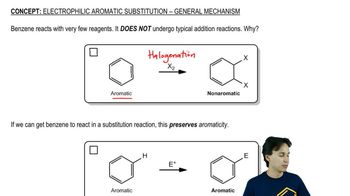
Electrophilic Aromatic Substitution (EAS)

Electrophilic Aromatic Substitution is a fundamental reaction in organic chemistry where an electrophile replaces a hydrogen atom on an aromatic ring. This process is crucial for synthesizing complex aromatic compounds, as it allows for the introduction of various functional groups. Understanding the mechanism of EAS, including the role of activating and deactivating groups, is essential for predicting the outcomes of reactions starting from benzene or toluene.
Recommended video:

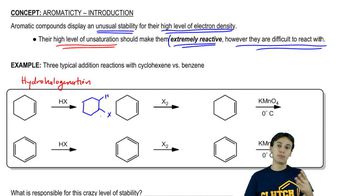
Reactivity of Aromatic Compounds

The reactivity of aromatic compounds, such as benzene and toluene, is influenced by the presence of substituents on the ring. Electron-donating groups (EDGs) enhance the reactivity towards electrophiles, while electron-withdrawing groups (EWGs) decrease it. In the context of synthesizing 1-phenyl-1-methoxybutane, recognizing how substituents affect the regioselectivity of EAS is vital, especially since para products are favored in this scenario.
Recommended video:
Guided course
08:19
Intro to Aromaticity

Synthesis of Alkoxy Compounds

The synthesis of alkoxy compounds involves the introduction of an alkoxy group (-O-R) into an organic molecule, often through reactions like nucleophilic substitution or EAS. In this case, the methoxy group can be introduced via a methanol reaction with a suitable electrophile. Understanding the conditions and reagents required for effective alkoxy group installation is key to successfully synthesizing the target compound from benzene or toluene.
Recommended video:
Guided course
01:40
Defining meso compounds.