Ch. 17 - Reactions of Aromatic Compounds
Wade - Organic Chemistry 9th Edition
Wade9th EditionOrganic ChemistryISBN: 9780135213728Not the one you use?Change textbook
Chapter 17, Problem 53b

Predict the major products of the following reactions.
(b) phenol + tert-butyl chloride + AlCl3

Verified step by step guidance
1
Step 1: Recognize the type of reaction. This is an example of a Friedel-Crafts alkylation reaction, where an aromatic compound (phenol) reacts with an alkyl halide (tert-butyl chloride) in the presence of a Lewis acid catalyst (AlCl₃). The reaction introduces an alkyl group onto the aromatic ring.
Step 2: Understand the role of the reagents. AlCl₃ acts as a Lewis acid to generate a carbocation from tert-butyl chloride. The tert-butyl carbocation (C(CH₃)₃⁺) is a highly stable tertiary carbocation, which will act as the electrophile in this reaction.
Step 3: Consider the directing effects of the hydroxyl (-OH) group on phenol. The -OH group is an activating and ortho/para-directing group, meaning it increases the reactivity of the aromatic ring and directs the incoming electrophile to the ortho and para positions relative to itself.
Step 4: Predict the major products. The tert-butyl group will preferentially add to the para position of the phenol due to steric hindrance at the ortho positions. However, some ortho substitution may also occur as a minor product.
Step 5: Draw the structures of the products. The major product will be para-tert-butylphenol, and the minor product will be ortho-tert-butylphenol. Ensure to represent the aromatic ring with the hydroxyl group and the tert-butyl group in the correct positions.

Verified video answer for a similar problem:

This video solution was recommended by our tutors as helpful for the problem above.
Video duration:
5m
Was this helpful?

Key Concepts

Here are the essential concepts you must grasp in order to answer the question correctly.

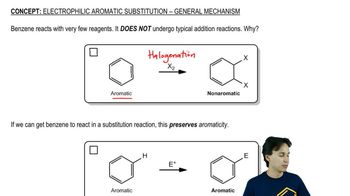
Electrophilic Aromatic Substitution

Electrophilic aromatic substitution (EAS) is a fundamental reaction in organic chemistry where an electrophile replaces a hydrogen atom on an aromatic ring. In the case of phenol, the hydroxyl group (-OH) activates the ring, making it more reactive towards electrophiles. Understanding EAS is crucial for predicting the products of reactions involving aromatic compounds.
Recommended video:

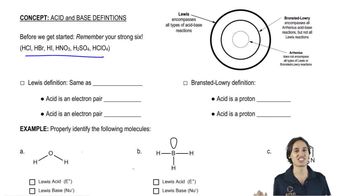
Lewis Acids and Bases

Lewis acids are species that can accept an electron pair, while Lewis bases donate an electron pair. In this reaction, AlCl3 acts as a Lewis acid, facilitating the formation of a more reactive electrophile from tert-butyl chloride. Recognizing the role of Lewis acids and bases is essential for understanding how they influence reaction mechanisms and product formation.
Recommended video:
Guided course
02:49
The Lewis definition of acids and bases.

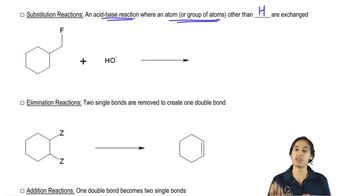
Regioselectivity in Substitution Reactions

Regioselectivity refers to the preference of a chemical reaction to occur at one location over another in a molecule. In the case of phenol reacting with tert-butyl chloride in the presence of AlCl3, the reaction will likely occur at the ortho or para positions due to the activating effect of the hydroxyl group. Understanding regioselectivity helps predict the major products formed in substitution reactions.
Recommended video:
Guided course
01:34
Recognizing Substitution Reactions.