Ch. 17 - Reactions of Aromatic Compounds
Wade - Organic Chemistry 9th Edition
Wade9th EditionOrganic ChemistryISBN: 9780135213728Not the one you use?Change textbook
Chapter 17, Problem 14b(iii)

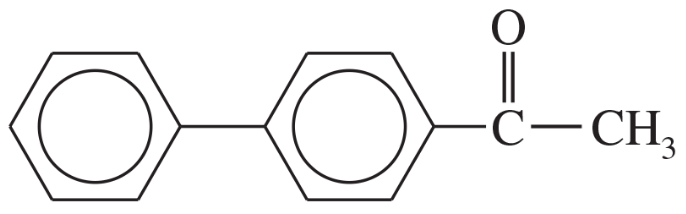
Biphenyl is two benzene rings joined by a single bond. The site of substitution for a biphenyl is determined by (1) which phenyl ring is more activated (or less deactivated), and (2) which position on that ring is most reactive, using the fact that a phenyl substituent is activating and ortho, para-directing.
b. Predict the mononitration products of the following compounds
(iii)

Verified step by step guidance
1
Step 1: Analyze the structure of the biphenyl compound provided. The molecule consists of two benzene rings connected by a single bond. One of the benzene rings has an acetyl group (-COCH₃) attached to it, which is an electron-withdrawing group.
Step 2: Understand the effect of the acetyl group on the reactivity of the benzene rings. The acetyl group is a deactivating group and meta-directing. It reduces the electron density on the benzene ring it is attached to, making it less reactive toward electrophilic substitution reactions compared to the unsubstituted benzene ring.
Step 3: Determine which benzene ring is more activated. The benzene ring without the acetyl group is more activated because it does not have an electron-withdrawing group attached. This ring will be the site of substitution for the nitration reaction.
Step 4: Predict the positions on the activated benzene ring that are most reactive. Since the phenyl substituent (the other benzene ring) is an activating group and ortho, para-directing, the nitration will occur at the ortho and para positions relative to the phenyl substituent on the activated benzene ring.
Step 5: Conclude the mononitration products. The nitration reaction will yield two possible products: one with the nitro group (-NO₂) at the ortho position and another with the nitro group at the para position relative to the phenyl substituent on the activated benzene ring.

Verified video answer for a similar problem:

This video solution was recommended by our tutors as helpful for the problem above.
Video duration:
2m
Was this helpful?

Key Concepts

Here are the essential concepts you must grasp in order to answer the question correctly.

Aromatic Substitution

Aromatic substitution is a key reaction in organic chemistry where an atom, typically hydrogen, in an aromatic compound is replaced by another atom or group. This process preserves the aromaticity of the compound, which is crucial for stability. The mechanism often involves electrophilic aromatic substitution (EAS), where an electrophile attacks the electron-rich aromatic ring.
Recommended video:
Guided course
08:19
Intro to Aromaticity

Activating and Deactivating Groups

Substituents on an aromatic ring can either activate or deactivate the ring towards electrophilic substitution. Activating groups, such as -OH or -CH3, increase the electron density of the ring, making it more reactive. Conversely, deactivating groups, like -NO2 or -COOH, withdraw electron density, making the ring less reactive. The nature of these groups influences the position of substitution (ortho, meta, or para).
Recommended video:
Guided course
03:27
Activating and deactivating groups

Ortho/Para Directing Effects

Ortho and para directing effects refer to the positions on an aromatic ring where new substituents are most likely to be added during electrophilic substitution. Activating groups typically direct incoming electrophiles to the ortho and para positions relative to themselves, while deactivating groups often direct them to the meta position. Understanding these directing effects is essential for predicting the products of substitution reactions.
Recommended video:
Guided course
04:42
Ortho, Para major products
Related Practice
Textbook Question

Propose products (if any) and mechanisms for the following AlCl3-catalyzed reactions:

c. 3-chloro-2,2-dimethylbutane with isopropylbenzene

1
views

Textbook Question

Biphenyl is two benzene rings joined by a single bond. The site of substitution for a biphenyl is determined by (1) which phenyl ring is more activated (or less deactivated), and (2) which position on that ring is most reactive, using the fact that a phenyl substituent is activating and ortho, para-directing.

b. Predict the mononitration products of the following compounds

(v)

4
views
Textbook Question

Propose products (if any) and mechanisms for the following AlCl3-catalyzed reactions:

b. methyl chloride with anisole

1
views
Textbook Question

Biphenyl is two benzene rings joined by a single bond. The site of substitution for a biphenyl is determined by (1) which phenyl ring is more activated (or less deactivated), and (2) which position on that ring is most reactive, using the fact that a phenyl substituent is activating and ortho, para-directing.

b. Predict the mononitration products of the following compounds

(i)

1
views
Textbook Question

Biphenyl is two benzene rings joined by a single bond. The site of substitution for a biphenyl is determined by (1) which phenyl ring is more activated (or less deactivated), and (2) which position on that ring is most reactive, using the fact that a phenyl substituent is activating and ortho, para-directing.

b. Predict the mononitration products of the following compounds

(ii)

1
views
Textbook Question

Propose products (if any) and mechanisms for the following AlCl3-catalyzed reactions:

a. chlorocyclohexane with benzene