
Ch. 17 - Reactions of Aromatic Compounds
Wade - Organic Chemistry 9th Edition
Wade9th EditionOrganic ChemistryISBN: 9780135213728Not the one you use?Change textbook
Chapter 17, Problem 14b(i)

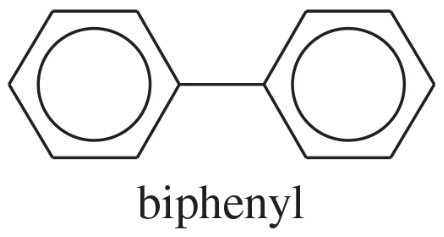
Biphenyl is two benzene rings joined by a single bond. The site of substitution for a biphenyl is determined by (1) which phenyl ring is more activated (or less deactivated), and (2) which position on that ring is most reactive, using the fact that a phenyl substituent is activating and ortho, para-directing.
b. Predict the mononitration products of the following compounds
(i)

Verified step by step guidance
1
Step 1: Understand the structure of biphenyl. Biphenyl consists of two benzene rings connected by a single bond. This single bond allows for some degree of rotation between the rings, but steric hindrance can limit this rotation.
Step 2: Analyze the activating and directing effects of the phenyl substituent. A phenyl group is an activating group and is ortho, para-directing. This means that substitution reactions will preferentially occur at the ortho or para positions relative to the phenyl group.
Step 3: Consider the nitration reaction. Nitration involves the introduction of a nitro group (-NO₂) into the aromatic ring. The nitro group is introduced by reacting the compound with a mixture of concentrated nitric acid (HNO₃) and sulfuric acid (H₂SO₄).
Step 4: Predict the site of substitution. In biphenyl, the phenyl group on one ring activates the ortho and para positions of the other ring. Since both rings are equivalent in biphenyl, the nitro group can be introduced at the ortho or para positions of either ring.
Step 5: Identify the mononitration products. The mononitration products of biphenyl will include nitro groups at the ortho and para positions relative to the phenyl substituent on either ring. These positions are the most reactive due to the activating effect of the phenyl group.

Verified video answer for a similar problem:

This video solution was recommended by our tutors as helpful for the problem above.
Video duration:
4m
Was this helpful?

Key Concepts

Here are the essential concepts you must grasp in order to answer the question correctly.

Biphenyl Structure

Biphenyl consists of two benzene rings connected by a single bond. This structure allows for rotation around the bond, which can influence the reactivity and orientation of substituents on the rings. Understanding the biphenyl structure is crucial for predicting the outcomes of electrophilic aromatic substitution reactions, such as nitration.
Recommended video:
Guided course
01:22
Determining if substituted biphenyls are chiral or not.

Electrophilic Aromatic Substitution (EAS)

Electrophilic aromatic substitution is a fundamental reaction in organic chemistry where an electrophile replaces a hydrogen atom on an aromatic ring. The reactivity of the ring is influenced by substituents already present, which can either activate or deactivate the ring towards further substitution. In biphenyl, the position of substitution is determined by the activating or deactivating effects of the substituents on each phenyl ring.
Recommended video:

Ortho/Para-Directing Effects

Substituents on an aromatic ring can direct incoming electrophiles to specific positions on the ring. Ortho and para directing groups, such as alkyl or -OH groups, increase the electron density at the ortho and para positions, making them more reactive. In the case of biphenyl, understanding which ring is more activated and the preferred substitution positions is essential for predicting the products of nitration.
Recommended video:
Guided course
04:42
Ortho, Para major products
Related Practice
Textbook Question

Biphenyl is two benzene rings joined by a single bond. The site of substitution for a biphenyl is determined by (1) which phenyl ring is more activated (or less deactivated), and (2) which position on that ring is most reactive, using the fact that a phenyl substituent is activating and ortho, para-directing.

b. Predict the mononitration products of the following compounds

(iv)

2
views
Textbook Question

Biphenyl is two benzene rings joined by a single bond. The site of substitution for a biphenyl is determined by (1) which phenyl ring is more activated (or less deactivated), and (2) which position on that ring is most reactive, using the fact that a phenyl substituent is activating and ortho, para-directing.

b. Predict the mononitration products of the following compounds

(vi)

1
views
Textbook Question

Biphenyl is two benzene rings joined by a single bond. The site of substitution for a biphenyl is determined by (1) which phenyl ring is more activated (or less deactivated), and (2) which position on that ring is most reactive, using the fact that a phenyl substituent is activating and ortho, para-directing.

b. Predict the mononitration products of the following compounds

(v)

4
views
Textbook Question

Biphenyl is two benzene rings joined by a single bond. The site of substitution for a biphenyl is determined by (1) which phenyl ring is more activated (or less deactivated), and (2) which position on that ring is most reactive, using the fact that a phenyl substituent is activating and ortho, para-directing.

b. Predict the mononitration products of the following compounds

(ii)

1
views
Textbook Question

Biphenyl is two benzene rings joined by a single bond. The site of substitution for a biphenyl is determined by (1) which phenyl ring is more activated (or less deactivated), and (2) which position on that ring is most reactive, using the fact that a phenyl substituent is activating and ortho, para-directing.

b. Predict the mononitration products of the following compounds

(iii)

1
views
Textbook Question

Propose products (if any) and mechanisms for the following AlCl3-catalyzed reactions:

a. chlorocyclohexane with benzene