Ch. 15 - Conjugated Systems, Orbital Symmetry, and Ultraviolet Spectroscopy
Wade - Organic Chemistry 9th Edition
Wade9th EditionOrganic ChemistryISBN: 9780135213728Not the one you use?Change textbook
Chapter 15, Problem 36e

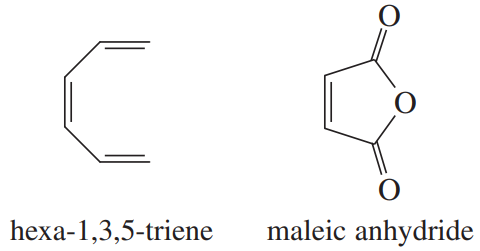
Show the Diels–Alder product that would actually result from heating hexa-1,3,5-triene with maleic anhydride.
Structural formulas of hexa-1,3,5-triene and maleic anhydride, labeled beneath each compound.

Verified step by step guidance
1
Step 1: Recognize that the Diels–Alder reaction involves a conjugated diene (hexa-1,3,5-triene) and a dienophile (maleic anhydride). The diene must adopt an s-cis conformation to participate in the reaction.
Step 2: Analyze the structure of hexa-1,3,5-triene. It contains three conjugated double bonds, and the central double bond allows rotation to achieve the s-cis conformation necessary for the reaction.
Step 3: Identify maleic anhydride as the dienophile. It contains a highly electron-deficient double bond due to the electron-withdrawing carbonyl groups, making it reactive toward the diene.
Step 4: Predict the cycloaddition mechanism. The diene and dienophile undergo a [4+2] cycloaddition, forming a six-membered ring. The new bonds are formed between the terminal carbons of the diene and the carbons of the dienophile's double bond.
Step 5: Consider the stereochemistry of the product. Maleic anhydride is symmetric, so the product will have the anhydride functional group attached to the six-membered ring. The reaction is stereospecific, resulting in a single stereoisomer.

Verified video answer for a similar problem:

This video solution was recommended by our tutors as helpful for the problem above.
Video duration:
6m
Was this helpful?

Key Concepts

Here are the essential concepts you must grasp in order to answer the question correctly.

Diels–Alder Reaction

The Diels–Alder reaction is a [4+2] cycloaddition between a conjugated diene and a dienophile, resulting in the formation of a six-membered ring. This reaction is thermally allowed and is characterized by the formation of new sigma bonds while maintaining the integrity of the pi systems. Understanding the stereochemistry and regioselectivity of this reaction is crucial for predicting the product.
Recommended video:
Guided course
04:02
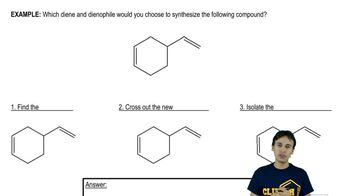
Diels-Alder Retrosynthesis

Conjugated Dienes

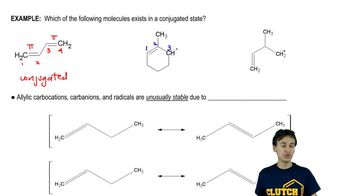
Conjugated dienes are compounds that contain two double bonds separated by a single bond, allowing for resonance stabilization. In the context of the Diels–Alder reaction, the diene must be in an s-cis conformation to effectively overlap with the dienophile. Recognizing the structure and reactivity of conjugated dienes is essential for predicting the outcome of the reaction.
Recommended video:
Guided course
03:27
Conjugated states

Dienophile

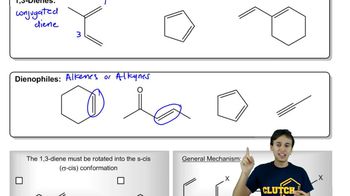
A dienophile is a compound that contains a double or triple bond and reacts with a diene in the Diels–Alder reaction. Maleic anhydride, a common dienophile, is electron-deficient, which enhances its reactivity towards electron-rich dienes like hexa-1,3,5-triene. Understanding the nature of the dienophile helps in predicting the regioselectivity and stereochemistry of the Diels–Alder product.
Recommended video:
Guided course
09:48
General Features