
Ch. 15 - Conjugated Systems, Orbital Symmetry, and Ultraviolet Spectroscopy
Wade - Organic Chemistry 9th Edition
Wade9th EditionOrganic ChemistryISBN: 9780135213728Not the one you use?Change textbook
Chapter 15, Problem 36b

Show the electronic configuration of the ground state of hexa-1,3,5-triene.

Verified step by step guidance
1
Step 1: Begin by identifying the molecular formula of hexa-1,3,5-triene. It is C6H8, and the structure consists of six carbon atoms in a chain with alternating double and single bonds (a conjugated system).
Step 2: Determine the hybridization of each carbon atom. In hexa-1,3,5-triene, the carbons involved in double bonds are sp² hybridized, while the carbons involved in single bonds are also sp² hybridized due to the conjugated system.
Step 3: Assign the electronic configuration for each carbon atom. For sp² hybridized carbons, the electronic configuration is: 1s² 2s¹ 2p². The sp² hybrid orbitals form sigma bonds, while the unhybridized p orbital participates in π bonding.
Step 4: Consider the π-electron system. In hexa-1,3,5-triene, there are three double bonds, contributing six π-electrons. These π-electrons are delocalized across the conjugated system, forming molecular orbitals.
Step 5: Summarize the electronic configuration of the molecule. The sigma framework is formed by sp² hybridized orbitals, while the π-electrons occupy the delocalized molecular orbitals in the conjugated system. This delocalization contributes to the stability of the molecule.

Verified video answer for a similar problem:

This video solution was recommended by our tutors as helpful for the problem above.
Video duration:
4m
Was this helpful?

Key Concepts

Here are the essential concepts you must grasp in order to answer the question correctly.

Hexa-1,3,5-triene Structure

Hexa-1,3,5-triene is a linear hydrocarbon with six carbon atoms and three double bonds located at the first, third, and fifth positions. This structure is part of the class of compounds known as polyenes, which are characterized by alternating single and double bonds. Understanding its structure is crucial for determining the electronic configuration, as the arrangement of atoms influences the distribution of electrons.
Recommended video:
Guided course
03:04
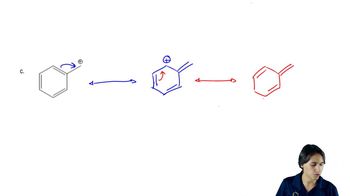
Drawing Resonance Structures

Electronic Configuration

The electronic configuration of an atom describes the distribution of electrons among the various orbitals. For carbon, which has four valence electrons, the configuration is typically represented as 1s² 2s² 2p². In the case of hexa-1,3,5-triene, the electronic configuration must account for the hybridization of carbon atoms involved in double bonds, which affects the overall electron arrangement in the molecule.
Recommended video:
Guided course
02:14
The Electron Configuration

Hybridization

Hybridization is the concept that describes the mixing of atomic orbitals to form new hybrid orbitals, which can explain the geometry and bonding properties of molecules. In hexa-1,3,5-triene, the carbon atoms involved in double bonds undergo sp² hybridization, leading to a trigonal planar arrangement around those carbons. This hybridization is essential for understanding the bonding and electronic configuration of the molecule.
Recommended video:
Guided course
10:43
Using bond sites to predict hybridization