

Ch. 15 - Conjugated Systems, Orbital Symmetry, and Ultraviolet Spectroscopy
Wade - Organic Chemistry 9th Edition
Wade9th EditionOrganic ChemistryISBN: 9780135213728Not the one you use?Change textbook
Chapter 15, Problem 27c

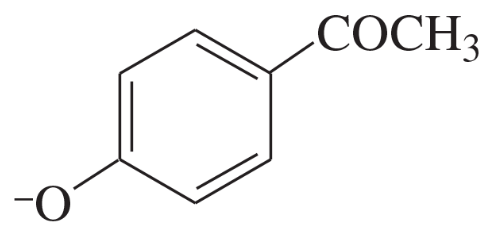
Draw the important resonance contributors for the following cations, anions, and radicals.
(c)

Verified step by step guidance
1
Identify the structure of the given species (cation, anion, or radical) and locate any pi bonds, lone pairs, or unpaired electrons that can participate in resonance.
Determine the possible movement of electrons. For cations, look for adjacent pi bonds or lone pairs that can donate electron density. For anions, look for lone pairs or pi bonds that can delocalize the negative charge. For radicals, consider the movement of the unpaired electron in conjunction with pi bonds.
Draw the resonance structures by moving electrons appropriately. Use curved arrows to indicate the movement of electrons: a single-headed arrow for radicals and a double-headed arrow for cations and anions.
Ensure that each resonance structure follows the rules of resonance: maintain the same number of electrons, avoid exceeding the octet rule for second-row elements, and ensure that the overall charge of the molecule remains the same.
Label the resonance contributors to indicate their relative importance. Typically, structures with full octets, minimal formal charges, and charges placed on atoms with appropriate electronegativity are more significant contributors.

Verified video answer for a similar problem:

This video solution was recommended by our tutors as helpful for the problem above.
Video duration:
2m
Was this helpful?

Key Concepts

Here are the essential concepts you must grasp in order to answer the question correctly.

Resonance Structures

Resonance structures are different Lewis structures for the same molecule that depict the same arrangement of atoms but differ in the placement of electrons. These structures help illustrate the delocalization of electrons within a molecule, which can stabilize cations, anions, and radicals. Understanding resonance is crucial for predicting the reactivity and stability of these species.
Recommended video:
Guided course
03:04
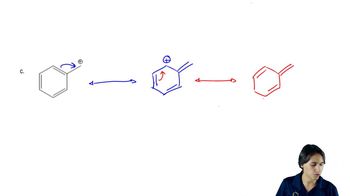
Drawing Resonance Structures

Cation Stability

Cations are positively charged species formed by the loss of electrons. Their stability is influenced by factors such as the degree of positive charge delocalization and the presence of electron-donating groups. Recognizing how resonance can distribute the positive charge across multiple atoms is essential for evaluating the stability of cations.
Recommended video:
0:52
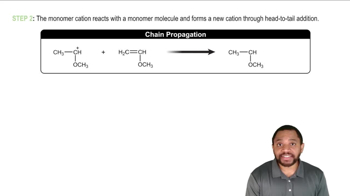
Cationic Polymerization Concept 3

Radical Stability

Radicals are species with unpaired electrons, making them highly reactive. The stability of radicals can be enhanced through resonance, where the unpaired electron can be delocalized over adjacent atoms. Understanding the factors that contribute to radical stability, including resonance and steric effects, is vital for analyzing their behavior in chemical reactions.
Recommended video:
Guided course
03:43
The radical stability trend.