Ch. 14 - Ethers, Epoxides, and Thioethers
Wade - Organic Chemistry 9th Edition
Wade9th EditionOrganic ChemistryISBN: 9780135213728Not the one you use?Change textbook
Chapter 14, Problem 53

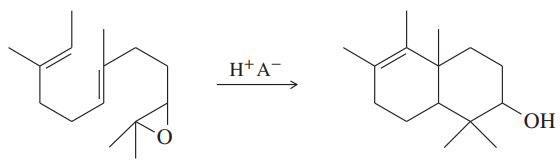
Under the right conditions, the following acid-catalyzed double cyclization proceeds in remarkably good yields. Propose a mechanism. Does this reaction resemble a biological process you have seen? 
Chemical reaction diagram illustrating acid-catalyzed double cyclization with reactants and products labeled.

Verified step by step guidance
1
Step 1: Protonation of the carbonyl group - The acid catalyst (H⁺) protonates the oxygen atom of the ketone group, increasing the electrophilicity of the carbonyl carbon. This makes the carbonyl carbon more susceptible to nucleophilic attack.
Step 2: Formation of the first ring - The double bond in the molecule acts as a nucleophile and attacks the protonated carbonyl carbon, leading to the formation of a new C-C bond and the first cyclization. This step generates a carbocation intermediate.
Step 3: Rearrangement and second cyclization - The carbocation formed in the previous step undergoes a rearrangement, and another double bond in the molecule acts as a nucleophile to attack the carbocation, forming the second ring. This results in a bicyclic intermediate.
Step 4: Deprotonation and stabilization - The intermediate formed undergoes deprotonation to stabilize the structure, leading to the formation of the final bicyclic compound with an alcohol group.
Step 5: Biological resemblance - This reaction resembles biological processes such as terpene biosynthesis, where carbocation intermediates and cyclizations are key steps in forming complex cyclic structures.

Verified video answer for a similar problem:

This video solution was recommended by our tutors as helpful for the problem above.
Video duration:
2m
Was this helpful?

Key Concepts

Here are the essential concepts you must grasp in order to answer the question correctly.

Acid-Catalyzed Reactions

Acid-catalyzed reactions involve the use of an acid to increase the rate of a chemical reaction. In these reactions, the acid donates a proton (H+) to a reactant, enhancing its electrophilicity and facilitating bond formation. This mechanism is crucial in organic chemistry, particularly in reactions like esterification and cyclization, where the formation of cyclic structures is promoted by protonation of functional groups.
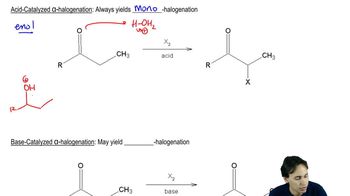
Recommended video:
Guided course
03:09
Acid Catalyzed

Cyclization Mechanisms

Cyclization mechanisms refer to the processes by which linear or branched molecules form cyclic structures. This can occur through various pathways, including nucleophilic attack, electrophilic addition, or radical processes. Understanding the specific steps involved in cyclization, such as the formation of new bonds and the rearrangement of electrons, is essential for predicting the products and yields of these reactions.
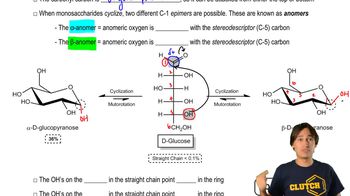
Recommended video:
Guided course
12:58
Monosaccharides - Cyclization

Biological Analogies in Organic Reactions

Many organic reactions can be likened to biological processes, particularly those catalyzed by enzymes. Enzymes often facilitate cyclization and other transformations in a highly efficient and selective manner, mimicking acid-catalyzed reactions in the lab. Recognizing these parallels can provide insights into reaction mechanisms and help in understanding how nature achieves complex transformations under mild conditions.
Recommended video:
Guided course
02:08
Organic molecules in your everyday life.
Related Practice
Textbook Question

Propylene oxide is a chiral molecule. Hydrolysis of propylene oxide gives propylene glycol, another chiral molecule.

(a) Draw the enantiomers of propylene oxide.

(b) Propose a mechanism for the acid-catalyzed hydrolysis of pure (R)-propylene oxide.

2
views
Textbook Question

One of the crowning achievements of natural products synthesis was Bryostatin 1, published by Professor Gary Keck (University of Utah; Journal of the American Chemical Society, 2011, 133, 744–747). The Bryostatins are a family of compounds isolated from aquatic invertebrates known as Bryozoans. The compounds are of interest for a variety of biological effects, including anti-cancer activity and reversing brain damage in rodents.

(d) How many chiral centers are in this molecule?

(e) Using the number of chiral centers you reported in part (d), calculate the number of stereoisomers possible at these chiral centers. (Ignore stereoisomers at double bonds.)

3
views
Textbook Question

An acid-catalyzed reaction was carried out using methyl cellosolve (2-methoxyethanol) as the solvent. When the 2-methoxyethanol was redistilled, a higher-boiling fraction (bp 162°C) was also recovered. The mass spectrum of this fraction showed the molecular weight to be 134. The IR and NMR spectra are shown here. Determine the structure of this compound, and propose a mechanism for its formation.

<IMAGE>

5
views
Textbook Question

A compound of molecular formula C8H8O gives the IR and NMR spectra shown here. Propose a structure, and show how it is consistent with the observed absorptions.

<IMAGE>

3
views
Textbook Question

In 2012, a group led by Professor Masayuki Satake of the University of Tokyo reported the isolation and structure determination of a toxin from a marine algal bloom that decimated the fish population off the New Zealand coast in 1998. Extensive mass spectrometry and NMR experiments ultimately led to the structure shown below, named Brevisulcenal-F. (See Journal of the American Chemical Society, 2012, 134, 4963–4968.) This structure holds the record for the largest number of fused rings, at 17.

(a) How many ether groups are present?

(b) How many alcohol groups are present? Classify the alcohols as 1° or 2° or 3°.

(c) Are there any other oxygen-containing functional groups? Which, if any?