
Ch. 14 - Ethers, Epoxides, and Thioethers
Wade - Organic Chemistry 9th Edition
Wade9th EditionOrganic ChemistryISBN: 9780135213728Not the one you use?Change textbook
Chapter 14, Problem 55

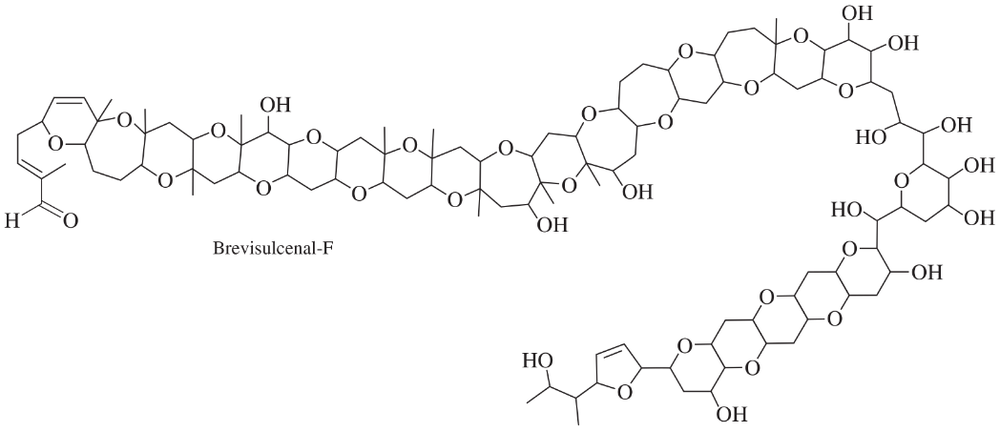
In 2012, a group led by Professor Masayuki Satake of the University of Tokyo reported the isolation and structure determination of a toxin from a marine algal bloom that decimated the fish population off the New Zealand coast in 1998. Extensive mass spectrometry and NMR experiments ultimately led to the structure shown below, named Brevisulcenal-F. (See Journal of the American Chemical Society, 2012, 134, 4963–4968.) This structure holds the record for the largest number of fused rings, at 17.

(a) How many ether groups are present?
(b) How many alcohol groups are present? Classify the alcohols as 1° or 2° or 3°.
(c) Are there any other oxygen-containing functional groups? Which, if any?

Verified step by step guidance
1
Examine the structure of Brevisulcenal-F carefully. Identify the oxygen atoms in the structure, as these are key to determining the presence of ether and alcohol groups.
Count the number of ether groups. An ether group is characterized by an oxygen atom connected to two carbon atoms (R-O-R'). Look for these connections in the structure.
Count the number of alcohol groups. An alcohol group is characterized by an oxygen atom bonded to a hydrogen atom (OH) and a carbon atom. Identify these groups and classify them as primary (1°), secondary (2°), or tertiary (3°) based on the number of carbon atoms attached to the carbon bearing the OH group.
Identify any other oxygen-containing functional groups. Look for groups such as carbonyls (C=O), carboxylic acids (COOH), esters (COOR), or others that may be present in the structure.
Summarize the findings: list the number of ether groups, the number and classification of alcohol groups, and any other oxygen-containing functional groups identified in the structure.

Verified video answer for a similar problem:

This video solution was recommended by our tutors as helpful for the problem above.
Video duration:
3m
Was this helpful?

Key Concepts

Here are the essential concepts you must grasp in order to answer the question correctly.

Ether Groups

Ether groups are characterized by an oxygen atom connected to two alkyl or aryl groups (R-O-R'). In the structure of Brevisulcenal-F, ether groups are identified by the presence of oxygen atoms within the ring system, bridging two carbon atoms. Counting these oxygen atoms within the fused rings will determine the number of ether groups present.
Recommended video:
Guided course
07:16
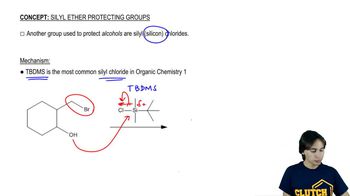
Mechanism of Silyl Ether Protecting Groups.

Alcohol Groups

Alcohol groups consist of a hydroxyl group (-OH) attached to a saturated carbon atom. They are classified based on the number of carbon atoms bonded to the carbon bearing the hydroxyl group: primary (1°), secondary (2°), or tertiary (3°). In Brevisulcenal-F, identifying the carbon connectivity around each -OH group will help classify the alcohols present.
Recommended video:
Guided course
03:01
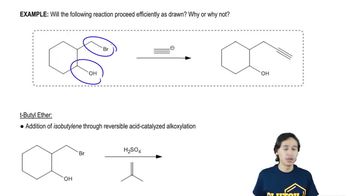
General features of Alcohol Protecting Groups.

Oxygen-Containing Functional Groups

Besides ethers and alcohols, other oxygen-containing functional groups include carbonyls, esters, and carboxylic acids. In Brevisulcenal-F, examining the structure for any additional oxygen atoms not part of ether or alcohol groups will reveal other functional groups, if present. This involves looking for characteristic structural features like C=O bonds.
Recommended video:
Guided course
02:36
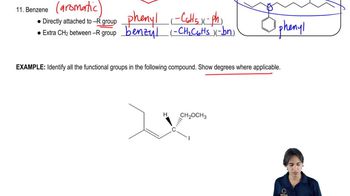
Identifying Functional Groups