
Ch. 14 - Ethers, Epoxides, and Thioethers
Wade - Organic Chemistry 9th Edition
Wade9th EditionOrganic ChemistryISBN: 9780135213728Not the one you use?Change textbook
Chapter 14, Problem 47

There are two different ways of making 2-ethoxyoctane from octan-2-ol using the Williamson ether synthesis. When pure (–)-octan-2-ol of specific rotation -8.24° is treated with sodium metal and then ethyl iodide, the product is 2-ethoxyoctane with a specific rotation of -15.6°. When pure (–)-octan-2-ol is treated with tosyl chloride and pyridine and then with sodium ethoxide, the product is also 2-ethoxyoctane. Predict the rotation of the 2-ethoxyoctane made using the tosylation/sodium ethoxide procedure, and propose a detailed mechanism to support your prediction.

Verified step by step guidance
1
Step 1: Understand the Williamson ether synthesis. This reaction involves the formation of an ether by reacting an alkoxide ion (generated from an alcohol and a strong base like sodium metal) with an alkyl halide. The stereochemistry of the product depends on the reaction mechanism, which is typically an SN2 process.
Step 2: Analyze the first pathway. When (-)-octan-2-ol is treated with sodium metal, it forms the alkoxide ion. This alkoxide ion reacts with ethyl iodide in an SN2 reaction, which inverts the stereochemistry at the chiral center. The product, 2-ethoxyoctane, has a specific rotation of -15.6°, indicating inversion of configuration.
Step 3: Examine the second pathway. When (-)-octan-2-ol is treated with tosyl chloride and pyridine, the hydroxyl group is converted into a tosylate group, which is a good leaving group. The stereochemistry at the chiral center is retained during this step because no bond-breaking occurs at the chiral center.
Step 4: In the second step of the second pathway, the tosylate reacts with sodium ethoxide in an SN2 reaction. The SN2 mechanism causes inversion of stereochemistry at the chiral center. Since the starting material (-)-octan-2-ol already had a specific rotation of -8.24°, the inversion will produce a product with the opposite configuration and a specific rotation of +8.24°.
Step 5: Compare the two pathways. The first pathway produces 2-ethoxyoctane with a specific rotation of -15.6°, while the second pathway produces 2-ethoxyoctane with a specific rotation of +8.24°. This difference arises because the first pathway involves a single inversion, while the second pathway involves retention followed by inversion, effectively leading to the opposite stereochemical configuration.

Verified video answer for a similar problem:

This video solution was recommended by our tutors as helpful for the problem above.
Video duration:
8m
Was this helpful?

Key Concepts

Here are the essential concepts you must grasp in order to answer the question correctly.

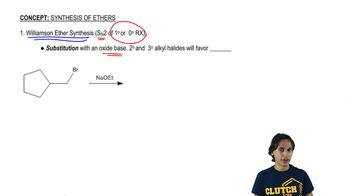
Williamson Ether Synthesis

The Williamson ether synthesis is a method for creating ethers by reacting an alkoxide ion with a primary alkyl halide. This reaction typically involves the nucleophilic attack of the alkoxide on the electrophilic carbon of the alkyl halide, leading to the formation of an ether. Understanding this mechanism is crucial for predicting the product and its stereochemistry when starting from chiral alcohols.
Recommended video:
Guided course
03:50
The Mechanism of Williamson Ether Synthesis.

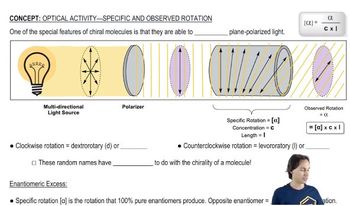
Specific Rotation

Specific rotation is a measure of how much a chiral compound rotates plane-polarized light, expressed in degrees. It is influenced by the compound's structure and the concentration of the solution. In this context, the specific rotation of the starting material and the product helps in determining the stereochemical outcome of the reactions, allowing for predictions about the optical activity of the synthesized ether.
Recommended video:
Guided course
05:43
Specific rotation vs. observed rotation.

Stereochemistry and Mechanism

Stereochemistry refers to the spatial arrangement of atoms in molecules and how this affects their chemical behavior. In the context of the question, the mechanism of the tosylation followed by nucleophilic substitution must be analyzed to understand how the stereochemistry of the starting material influences the final product. This includes recognizing whether the reaction proceeds via an inversion of configuration or retains the original configuration, which is essential for predicting the specific rotation of the resulting ether.
Recommended video:
1:38
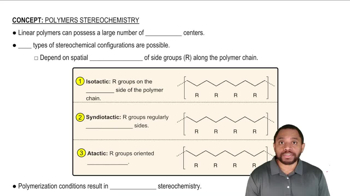
Polymer Stereochemistry Concept 1