
Propylene oxide is a chiral molecule. Hydrolysis of propylene oxide gives propylene glycol, another chiral molecule.
(a) Draw the enantiomers of propylene oxide.
(b) Propose a mechanism for the acid-catalyzed hydrolysis of pure (R)-propylene oxide.
Verified step by step guidance
Propylene oxide is a chiral molecule. Hydrolysis of propylene oxide gives propylene glycol, another chiral molecule.
(a) Draw the enantiomers of propylene oxide.
(b) Propose a mechanism for the acid-catalyzed hydrolysis of pure (R)-propylene oxide.
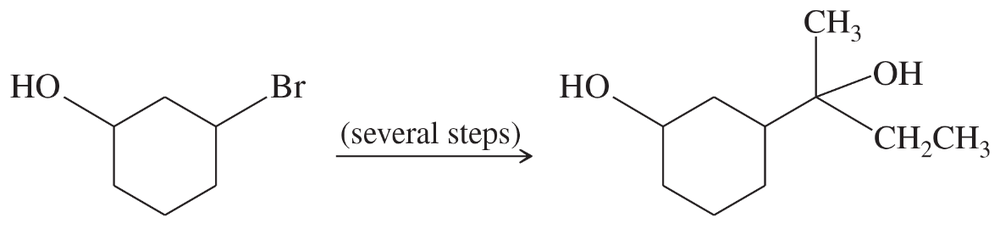
Show how you would synthesize the following ethers in good yield from the indicated starting materials and any additional reagents needed.
(d) 1-methoxydecane from a decene
There are two different ways of making 2-ethoxyoctane from octan-2-ol using the Williamson ether synthesis. When pure (–)-octan-2-ol of specific rotation -8.24° is treated with sodium metal and then ethyl iodide, the product is 2-ethoxyoctane with a specific rotation of -15.6°. When pure (–)-octan-2-ol is treated with tosyl chloride and pyridine and then with sodium ethoxide, the product is also 2-ethoxyoctane. Predict the rotation of the 2-ethoxyoctane made using the tosylation/sodium ethoxide procedure, and propose a detailed mechanism to support your prediction.
An acid-catalyzed reaction was carried out using methyl cellosolve (2-methoxyethanol) as the solvent. When the 2-methoxyethanol was redistilled, a higher-boiling fraction (bp 162°C) was also recovered. The mass spectrum of this fraction showed the molecular weight to be 134. The IR and NMR spectra are shown here. Determine the structure of this compound, and propose a mechanism for its formation.
<IMAGE>
Show how you would synthesize the following ethers in good yield from the indicated starting materials and any additional reagents needed.
(f) trans-2,3-epoxyoctane from octan-2-ol
Show how you would synthesize the following ethers in good yield from the indicated starting materials and any additional reagents needed.
(e) 1-ethoxy-1-methylcyclohexane from 2-methylcyclohexanol